







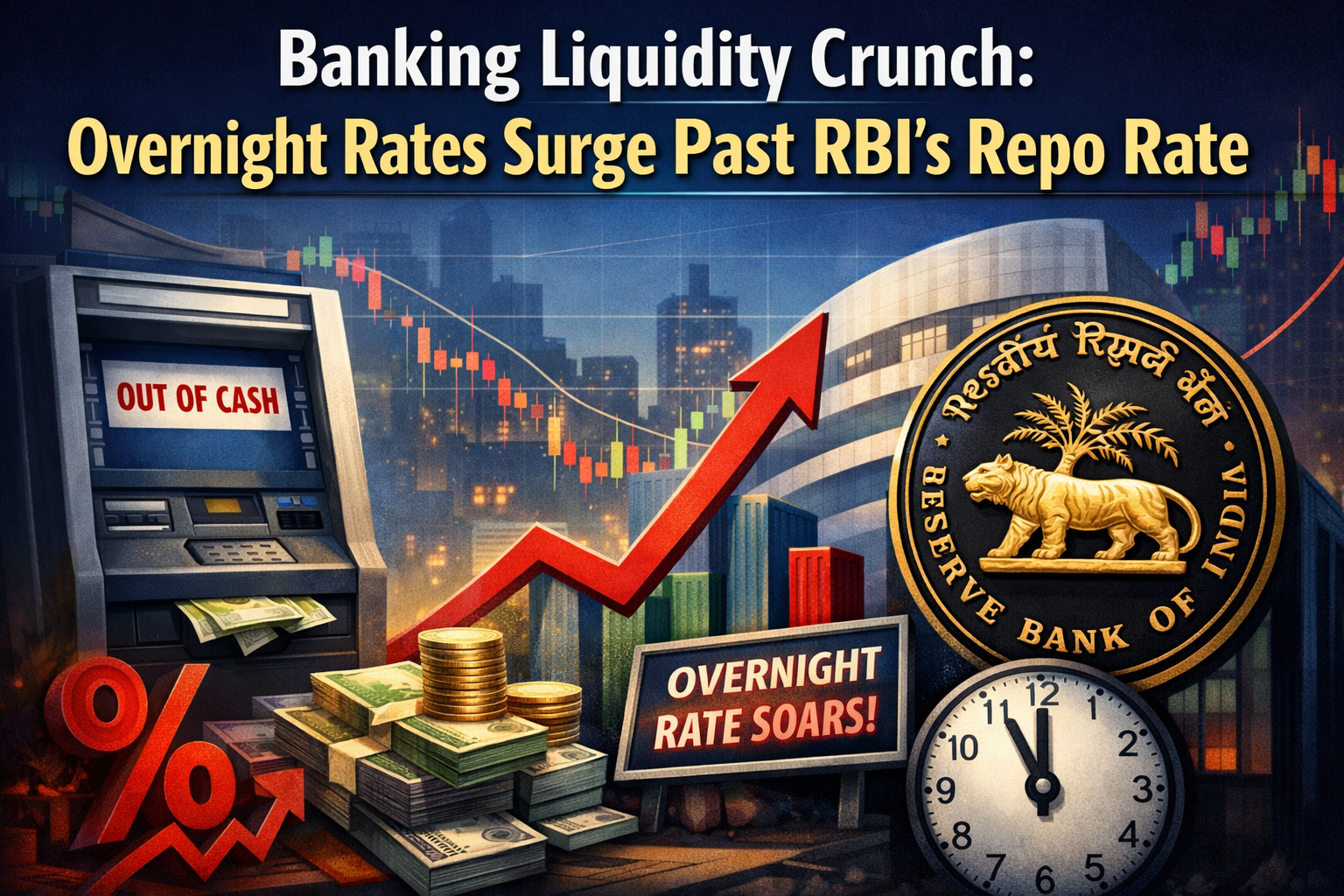
The Indian banking system is facing a significant cash squeeze this week, driving short-term borrowing costs well above the central bank’s benchmark. As corporate India clears its advance tax obligations, the sudden outflow of funds has pushed the system from a comfortable surplus into a deficit.
The Rate Spike: Breaking the Repo Ceiling
Typically, the Weighted Average Call Rate (WACR) stays closely aligned with the RBI’s Repo Rate, currently at 5.25%. However, the liquidity drain has forced rates to climb:
- Dec 15: 5.25% (Balanced/Surplus)
- Dec 16: 5.41% (Deficit begins)
- Dec 17: 5.46% (Peak tightness)
- Dec 18: 5.36% (Slight easing)
With rates trading 10–15 basis points above the repo rate, the market is signaling a clear “scarcity” of immediate funds.
What Triggered the Deficit?
The primary culprit is the quarterly advance tax payment cycle. When corporations move massive funds from commercial banks to the government’s account, it creates a temporary vacuum in the banking system.
Current Deficit Snapshot:
- Dec 16: ₹60,787.81 Crore deficit
- Dec 17: ₹68,586.12 Crore deficit
- Dec 18: ₹29,910.12 Crore deficit
This marks the first time since October 28, 2025, that the banking system has slipped into the red, despite the RBI’s active use of Variable Rate Repo (VRR) auctions and Open Market Operations (OMOs) to inject cash.
The RBI’s Firefighting Measures
To prevent the squeeze from destabilizing the markets, the RBI has been active:
- OMO Purchases: An auction on December 18 infused ₹50,000 crore into the system.
- VRR Auctions: The central bank is leaning heavily on Variable Rate Repos to modulate daily liquidity.
- USD/INR Swaps: Using currency tools to manage the rupee-liquidity balance.
The Outlook: Is the Pressure Cooling?
Market experts believe this “liquidity winter” is transient. While GST outflows expected on December 20 may provide one last hurdle, the pressure is expected to ease as government spending kicks back into the system.
The RBI is unlikely to announce further OMO purchases this month, choosing instead to use surgical VRR auctions to keep the system stable through the end of the year.
Key Takeaways for Investors:
- Short-term volatility: Expect money market instruments (CPs and CDs) to see slightly higher yields in the near term.
- RBI Stance: The central bank remains in “watchdog” mode, ensuring the deficit doesn’t spiral into a long-term credit crunch.