






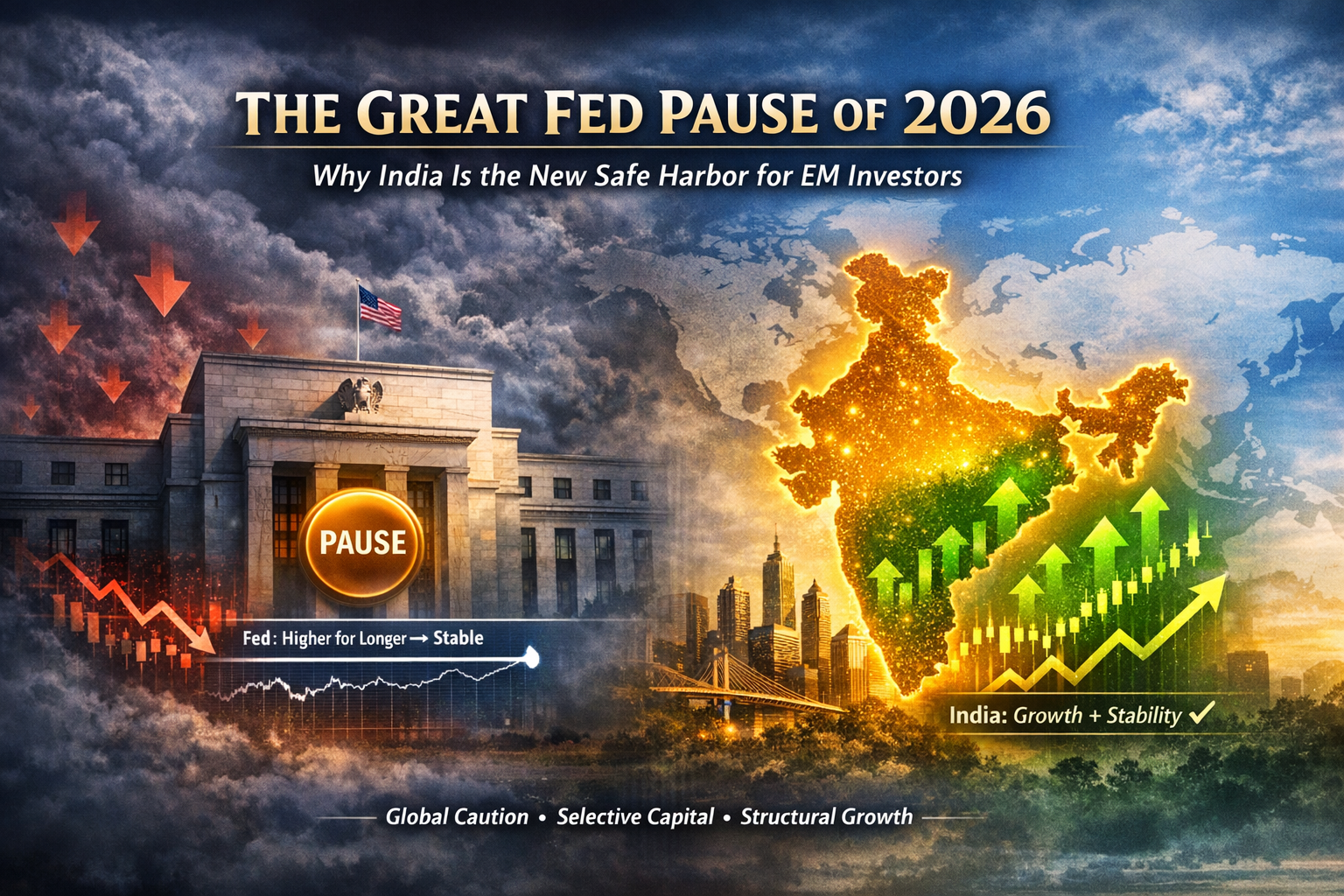
The global financial landscape of 2026 has arrived at a paradoxical junction. While the U.S. Federal Reserve has spent the last year easing the brakes, the latest signals from Washington suggest a significant shift: the Great Pause.
For Emerging Market (EM) investors, a “pause” is rarely just a breather—it is a signal of caution. As the Fed holds its benchmark rate steady in the 3.50%–3.75% range, the “Goldilocks” scenario of 2025 is being replaced by a more complex, data-dependent reality.
For India, the world’s fastest-growing major economy, this Fed outlook acts as both a stress test and a strategic opportunity. Here is a deep dive into why the Fed’s caution is making waves in Mumbai and what it means for your portfolio.
1. The “Pause” Logic: Why the Fed is Hesitating
The Federal Reserve enters 2026 facing a “sticky” problem. Despite multiple cuts in 2025, U.S. inflation has plateaued around 3%, refusing to drop to the elusive 2% target.
- The Trump Factor: Emerging trade tariffs and fiscal stimulus under the current administration have introduced new inflationary pressures.
- The Labor Paradox: While hiring has slowed, the U.S. consumer remains resilient. Fed officials, including NY Fed President John Williams, have signaled that there is no “urgent need” to cut further if the economy isn’t cooling fast enough.
The EM Catch-22: When the Fed pauses, the “carry trade” (borrowing in dollars to invest in higher-yielding EM assets) loses its momentum. Investors stop chasing growth and start weighing the “risk-free” return of a 3.75% Treasury yield against the volatility of emerging equities.
2. Impact on India: The Resilience vs. Liquidity Tug-of-War
India is currently a “divergent” story. While other EMs struggle with structural debt, India’s macro fundamentals are arguably at their strongest in a decade. However, no market is an island.
The FII Exodus vs. DII Resilience
In late 2025, India witnessed record outflows from Foreign Institutional Investors (FIIs), with over ₹1.5 lakh crore pulled out in a single quarter. A Fed pause likely extends this “wait-and-watch” sentiment.
- The Risk: If U.S. yields remain high, global funds may continue to reallocate toward developed markets or “safe” havens like gold (which is eyeing new highs in 2026).
- The Buffer: Domestic Institutional Investors (DIIs) and the relentless surge of SIP (Systematic Investment Plan) inflows have become India’s “Great Wall.” In 2026, the question is no longer if FIIs return, but whether domestic liquidity can continue to absorb the selling pressure.
The Rupee’s Tightrope Walk
The Indian Rupee (INR) has faced a tumultuous transition, recently breaching the 91 per dollar mark.
- Imported Inflation: A Fed pause keeps the Dollar Index (DXY) relatively firm. For a country that imports 85% of its crude oil, a weak rupee is an inflation tax.
- RBI Strategy: The Reserve Bank of India (RBI) has shifted to a more “market-driven” exchange rate. While this preserves forex reserves (still healthy at ~$690 billion), it increases volatility for Indian corporates with external borrowings.
3. Sectoral Winners and Losers in a “Paused” World
In a 2026 environment defined by Fed caution, “alpha” won’t come from broad index buying but from clinical sector selection.
The global financial landscape of 2026 has arrived at a paradoxical junction. While the U.S. Federal Reserve has spent the last year easing the brakes, the latest signals from Washington suggest a significant shift: the Great Pause.
For Emerging Market (EM) investors, a “pause” is rarely just a breather—it is a signal of caution. As the Fed holds its benchmark rate steady in the 3.50%–3.75% range, the “Goldilocks” scenario of 2025 is being replaced by a more complex, data-dependent reality.
For India, the world’s fastest-growing major economy, this Fed outlook acts as both a stress test and a strategic opportunity. Here is a deep dive into why the Fed’s caution is making waves in Mumbai and what it means for your portfolio.
| Sector | Outlook | Why? |
| Banking & NBFCs | Cautious | High global rates keep the cost of funds elevated. Credit growth remains strong, but margins may be squeezed if the RBI doesn’t follow with aggressive domestic cuts. |
| IT Services | Positive | A stronger dollar benefits rupee revenues. Furthermore, the 2026 “AI capex wave” in the U.S. is finally trickling down to Indian mid-cap tech execution. |
| Real Estate | Neutral | This sector is sensitive to domestic rates. If the Fed’s pause prevents the RBI from cutting further, the “housing boom” might see a slight cooling in 2026. |
| Renewables | Very Positive | Independent of Fed cycles, India’s green transition is fueled by domestic policy and FDI that is looking for long-term structural bets. |
4. The 2026 Investor Playbook: Navigating the Caution
If you are managing an India-focused portfolio, the Fed’s pause isn’t a reason to exit but a reason to upgrade.
- Focus on “Quality” Large Caps: High interest rates globally punish overleveraged companies. Stick to “cash cows” with low debt-to-equity ratios.
- Monitor the Yield Differential: The gap between U.S. 10-year Treasuries and India’s G-Sec is at its narrowest in a decade (~2.5%). Until this widens (either via lower U.S. rates or higher India yields), expect choppy FII behavior.
- The Earnings Anchor: 2026 is the year of “Earnings Realism.” With valuations in the Nifty 50 still trading at a premium compared to other EMs (PEG ratio of ~1.1x vs. U.S. 2.0x), stock prices will only move if the bottom line follows.
Conclusion: A Marathon, Not a Sprint
The Fed’s “Pause of 2026” is a reminder that the easy money era is truly in the rearview mirror. For India, the impact is a double-edged sword: it creates short-term currency and liquidity pain, but it also highlights India’s status as the “primary engine of global growth” (projected at 6.5%–7% for FY26).
Caution is the watchword, but for the discerning investor, volatility in 2026 is simply a chance to buy into the world’s most resilient growth story at a more reasonable price.