








For the past three years, investors have piled into “AI stocks” the way they piled into cloud stocks in 2015—chasing a theme. That era is over. What’s replacing it is something quieter, deeper, and far more durable.
From theme to infrastructure
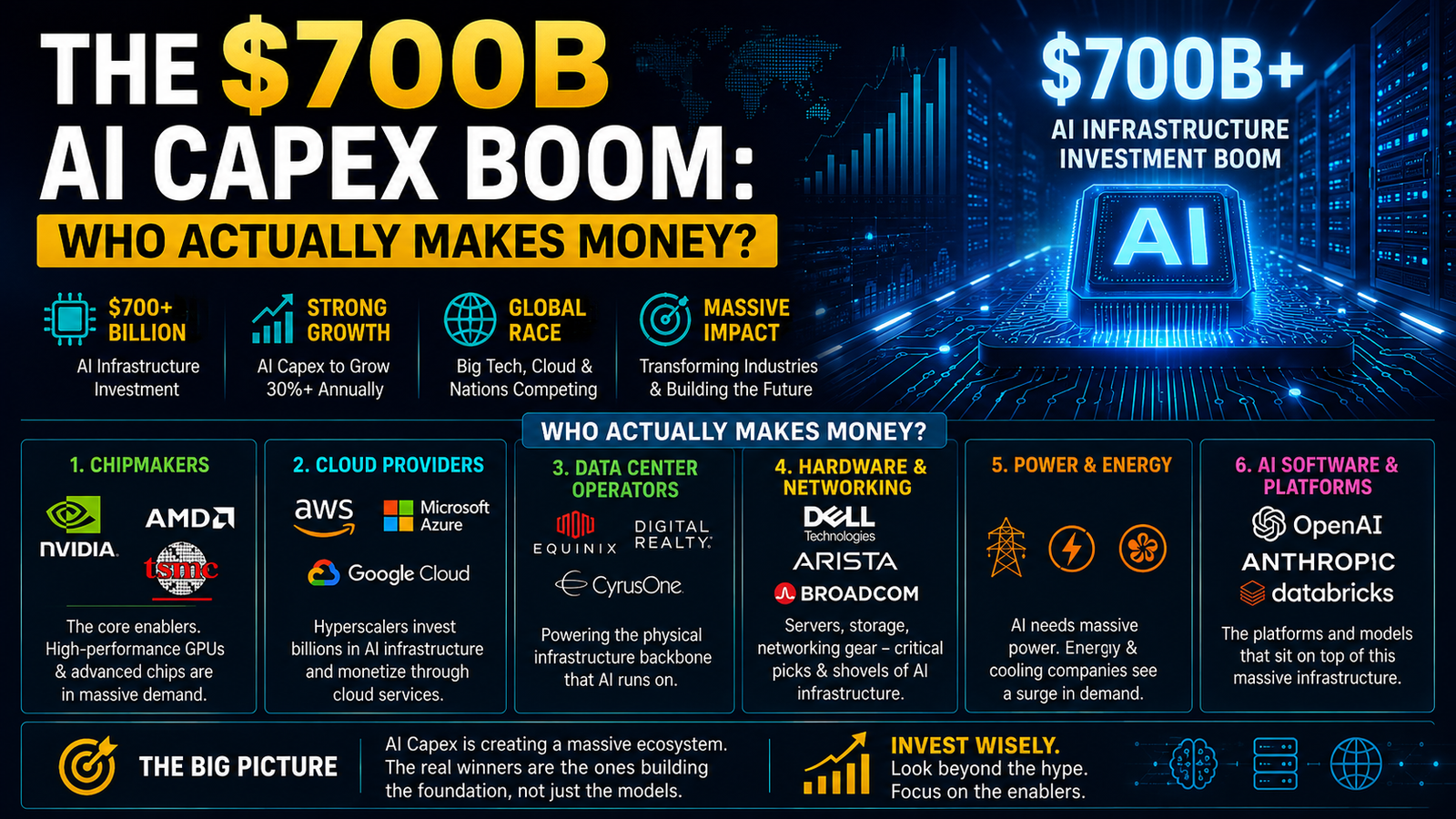
Theme trades have a lifecycle: hype, concentration, correction, and then—for the real ones—diffusion into the broader economy. We are now firmly in that diffusion phase. AI is no longer an identifiable “sector.” It is the operating system of modern enterprise. Capital spending on AI infrastructure by the top five cloud providers has crossed $300 billion annually. Every S&P 500 company now reports AI initiatives in earnings calls. The question is no longer whether AI matters — it’s which companies are structurally advantaged by it.
“When a technology becomes infrastructure, the market stops pricing it as a bet and starts pricing it as a requirement.”
$300B+
Annual AI capex, top 5 cloud providers
78%
S&P 500 firms with active AI deployment
4.2×
Productivity lift in AI-native workflows
What a market structure shift actually means
A theme trade rewards early movers and punishes latecomers. A market structure shift rewards sustained competitive advantage. The distinction matters for portfolio construction. In a theme trade, you buy the rumor and sell the news. In a structural shift, you hold through volatility because the underlying economics keep compounding.
Consider what happened to cloud computing. Amazon Web Services, dismissed as a side project in 2010, now generates more operating income than Amazon’s retail business. The market didn’t price that in during the “cloud theme” years of 2013–2016. It priced it in slowly, then suddenly.
Where capital is actually flowing in 2026
Three layers of the AI stack are seeing durable capital formation: compute infrastructure (semiconductors, custom silicon, and energy); platform middleware (model APIs, orchestration, and data pipelines); and vertical application software where AI delivers measurable ROI—legal, healthcare, financial services, and defense. Investors chasing the “hot AI stock of the week” are playing the wrong game. The real money in 2026 is being made by those who mapped the stack and bought the picks-and-shovels two years ago.
The risk hiding in plain sight
Not every AI stock is an AI investment. Dozens of companies appended “AI” to their names or issued breathless press releases in 2023–2024 without substantive integration. As the market matures, differentiation between genuine AI-native businesses and AI-branded marketing vehicles is accelerating. Valuation multiples are compressing for the latter. The structural winners will be those with proprietary data, distribution moats, and demonstrated unit economics — not just a ChatGPT integration.