







🎯 The Bold Vision
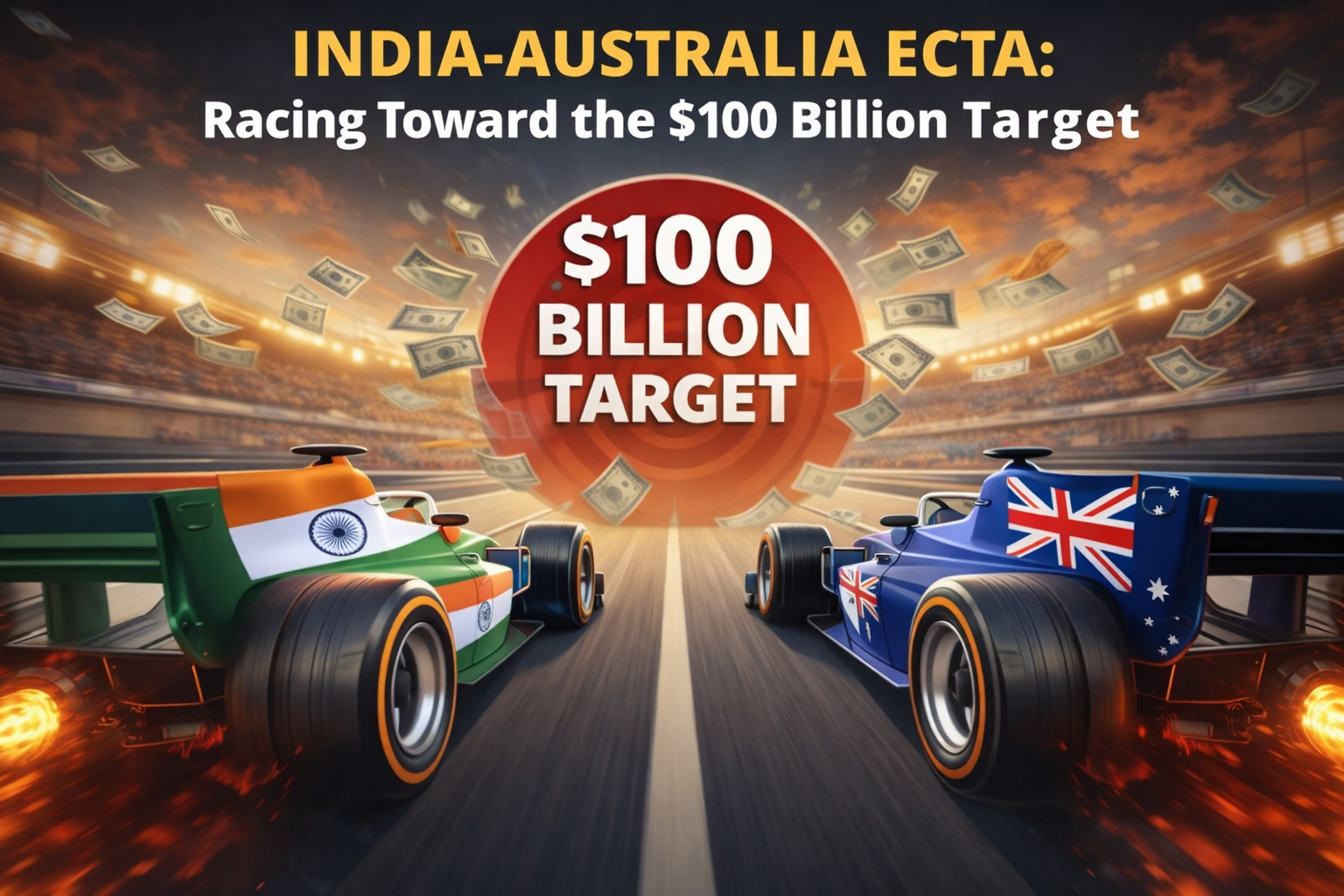
When India and Australia signed the Economic Cooperation and Trade Agreement (ECTA) on April 2, 2022, they set an audacious target: bilateral trade worth AUD 100 billion by 2030. As we enter 2026, the partnership is accelerating—but is the $100 billion dream realistic?
📊 The Numbers That Matter
Current Trade Snapshot (FY 2024-25):
- Total Bilateral Trade: USD 24.1 billion
- India’s Exports to Australia: USD 8.58 billion (up 8% YoY)
- India’s Imports from Australia: USD 15.52 billion
- Trade Balance: India maintains a deficit of ~USD 6.94 billion
Historical Context: The journey has been impressive. Bilateral trade has doubled from USD 12.2 billion in FY 2020-21 to the current levels, though it peaked at USD 26 billion in FY 2022-23 before moderating.
Recent Momentum (April-November 2024): Bilateral merchandise trade reached USD 16.3 billion, signaling strong continued momentum in the current fiscal year.
🚀 Game-Changing Milestone: January 1, 2026
A historic shift just occurred. From January 1, 2026, 100% of Australia’s tariff lines moved to zero duty for Indian exports under ECTA. This is expected to provide a massive boost to Indian exporters, particularly in:
- Textiles & Apparel
- Leather Products
- Engineering Goods
- Gems & Jewelry
- Processed Foods
- Pharmaceuticals
For perspective, over 85% of Australian goods exports to India are now tariff-free, rising to 90% by January 2026. Meanwhile, 96% of Indian imports to Australia were already tariff-free, now reaching 100%.
🎣 Success Story: The Salmon Surge
Australia has become India’s leading source of fresh and chilled salmon, overtaking Norway. Tasmanian salmon now accounts for 75% of India’s fresh whole Atlantic salmon imports—a dramatic jump from just 25% in 2023.
The secret? ECTA reduced import duties on salmon from 30% to 12.9%, with complete elimination expected by 2028. This competitive pricing advantage showcases ECTA’s real-world impact on trade flows.
🔍 Beyond ECTA: The CECA Negotiations
The Comprehensive Economic Cooperation Agreement (CECA) is now in progress, with 10 formal rounds and multiple inter-sessional discussions completed as of December 2024. CECA aims to build on ECTA’s foundation with deeper integration across:
- Advanced services trade
- Investment protection
- Regulatory cooperation
- Digital economy frameworks
- Critical minerals partnerships
💡 Strategic Context: Why This Matters
For India:
- Diversification away from over-reliance on traditional markets
- Access to Australia’s critical minerals (lithium, cobalt, rare earths) for clean energy transition
- Counter to recent US tariff pressures (50% tariffs imposed August 2025)
- Strengthened Indo-Pacific positioning through the Quad partnership
For Australia:
- First-mover advantage in the world’s fastest-growing large economy
- Access to 1.4 billion consumers
- Deepening strategic ties in a critical region
- Enhanced supply chain resilience
🎯 The $100 Billion Question
To hit the AUD 100 billion target by 2030, bilateral trade needs to grow at approximately 25-30% annually from current levels. Is this achievable?
Optimistic Factors: ✅ Complete tariff elimination (Jan 2026) ✅ Strong CECA negotiations underway ✅ Growing strategic convergence ✅ India’s expanding economy (projected to be 3rd largest by 2027) ✅ Increasing two-way investment flows
Challenges: ⚠️ Trade moderated from USD 26B (FY23) to USD 24B (FY24) ⚠️ India maintains persistent trade deficit ⚠️ Global economic headwinds ⚠️ Need for significant infrastructure investment
📈 What’s Next?
The partnership enters its third year with solid fundamentals. Key developments to watch in 2026:
- Third India-Australia 2+2 Ministerial Dialogue for defense and strategic cooperation
- CECA conclusion potentially by late 2026
- Critical minerals cooperation through KABIL-CMFO MoU implementation
- Services sector liberalization under ongoing negotiations
💼 The Bottom Line
The India-Australia ECTA has transformed from an agreement on paper to a living, breathing trade relationship. With 100% Australian tariff elimination now in effect and CECA negotiations advancing, the infrastructure for exponential growth is in place.
Will we hit $100 billion by 2030? The fundamentals suggest we’re on track, but execution will be everything. The next 12-18 months will be critical as both nations capitalize on the complete tariff elimination and finalize CECA.
One thing is certain: in an increasingly fragmented global trade environment, this India-Australia partnership represents what pragmatic, values-based economic cooperation can achieve.
What’s your take? Is the $100 billion target realistic or too ambitious?
Share your thoughts in the comments below.
#IndiaTrade #AustraliaTrade #ECTA #GlobalTrade #IndoPacific #TradeAgreements #EconomicPartnership #TheBigPicture
The Big Picture brings you data-driven analysis of the deals, policies, and partnerships shaping global commerce. Subscribe for daily insights.
Sources: Government of India Ministry of Commerce, Australian DFAT, IBEF, India Brand Equity Foundation (January 2025)