



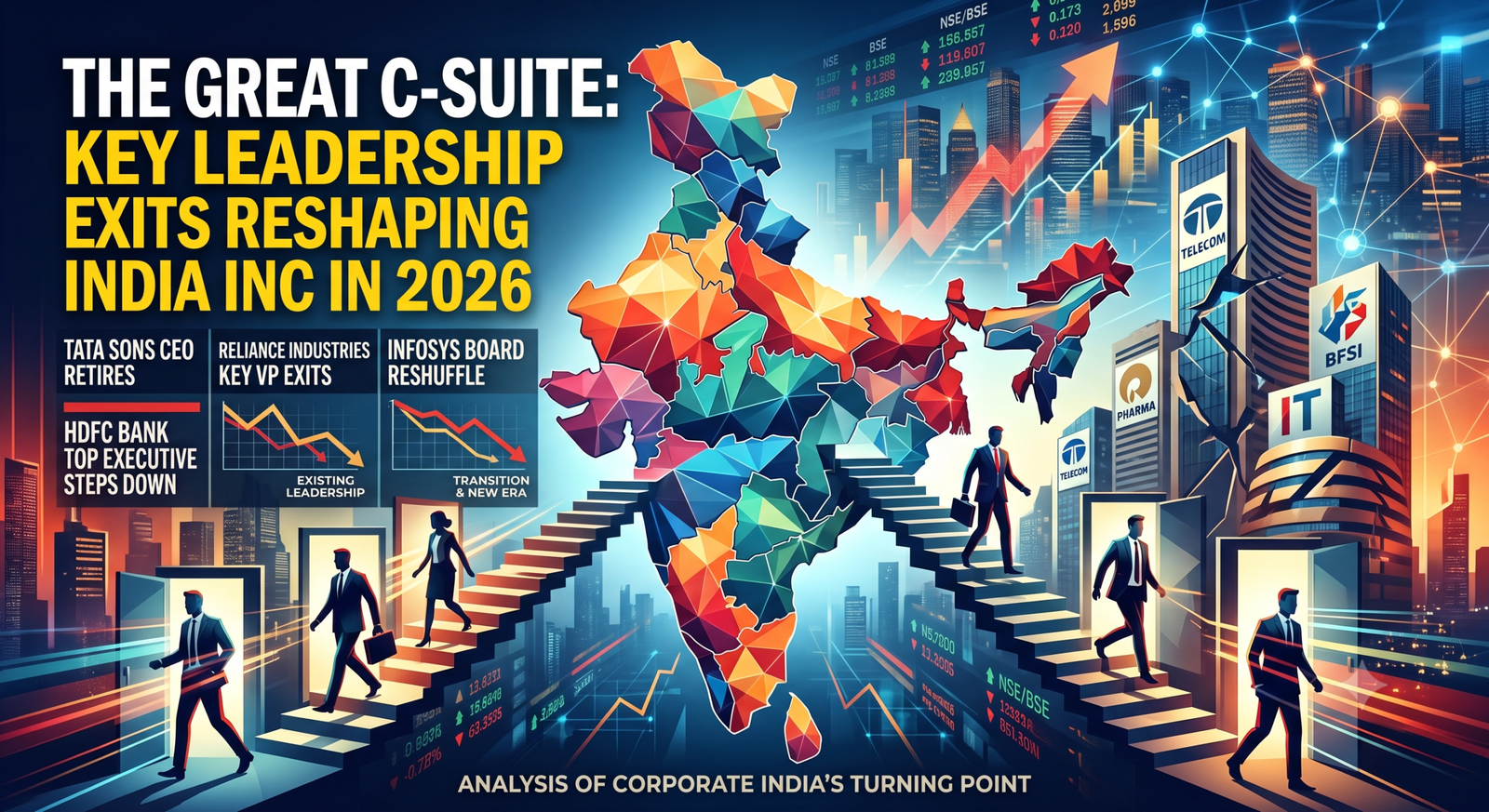
The Indian corporate landscape is experiencing a transformative phase as a wave of high-profile boardroom exits sweeps across traditional conglomerates, banking heavyweights, consumer giants, and global tech platforms.
From legacy transitions at Tata Sons and HDFC Bank to top tech executives migrating toward frontier artificial intelligence ventures, these departures signal strategic pivots, governance recalibrations, and generational succession across major industries.
1. Tata Sons: N. Chandrasekaran’s Historic Tenure Nears Completion
- Role: Executive Chairman, Tata Sons
- Key Context: Four-decade Tata Group veteran; stepped up to head Tata Sons in 2017 after leading TCS.
- Transition: In August 2026, Chandrasekaran informed the board that he will not pursue another term following the end of his current tenure on February 20, 2027.
During his nearly decade-long leadership at Bombay House, Chandrasekaran steered the conglomerate through critical modernizations—simplifying cross-holdings, expanding digital and semiconductor footprints, consolidating aviation assets under Air India, and scaling EV manufacturing. His planned departure sets the stage for one of corporate India’s most closely watched succession planning exercises.
2. HDFC Bank: Dual Executive Reshuffle at India’s Lending Titan
India’s largest private lender has encountered significant governance and executive transitions following its landmark mega-merger with HDFC Ltd:
- Sashidhar Jagdishan (MD & CEO): After nearly 30 years at the institution, Jagdishan opted not to seek a third term as MD & CEO. He guided the bank through the complex post-merger integration of mortgages, deposits, and regulatory adjustments.
- Atanu Chakraborty (Former Part-Time Chairman): The former Economic Affairs Secretary stepped down earlier in 2026 citing ethical differences, prompting independent external reviews and reinforcing the market’s focus on institutional oversight and transparency.
3. FMCG & Aviation: Unexpected Departures and Turnaround Tests
- Sudhir Sitapati (Godrej Consumer Products Ltd – GCPL): In a surprise move on August 11, Sitapati resigned as MD & CEO—just days after shareholders had approved a five-year contract renewal. The sudden exit, which led to the appointment of Aasif Malbari, underscored investor sensitivity to sudden strategy resets in the fast-moving consumer goods sector.
- Campbell Wilson (Air India): As CEO leading the multi-billion-dollar turnaround, fleet modernization, and integration of Vistara and Air India, Wilson’s leadership trajectory remains a core barometer for the airline’s long-term profitability and operational reliability.
4. Big Tech to Frontier AI: Talent Migration to OpenAI India
A defining corporate trend of 2026 is the rapid pull of senior leadership from multinational tech platforms into artificial intelligence ventures expanding their domestic footprint:
- Prabhjeet Singh: Stepped down as President of Uber India and South Asia to take charge as Managing Director for OpenAI India, leading enterprise partnerships, policy engagement, and AI infrastructure initiatives.
- Sandhya Devanathan: Transitioned out of Meta India after an impactful decade-long leadership career across Southeast Asia and India, reflecting the growing migration of top commercial tech executives toward generative AI platforms.
Strategic Takeaways for Market Observers
| Dimension | Market & Corporate Implication |
| Succession Planning | Boardrooms are increasingly emphasizing orderly internal pipelines over sudden external appointments. |
| Governance Scrutiny | Institutional investors and regulators are demanding clearer communication around C-suite departures and strategy continuity. |
| AI Talent Gravity | Top-tier executive leadership is aggressively pivoting toward next-generation AI infrastructure and enterprise deployment in India. |