








NSE Could Open a New Chapter for Its Own Shares
The National Stock Exchange of India (NSE) could soon create an unusual situation in the Indian capital market: its own shares may become available for trading on the NSE platform, even though the company would formally list its shares on another exchange.
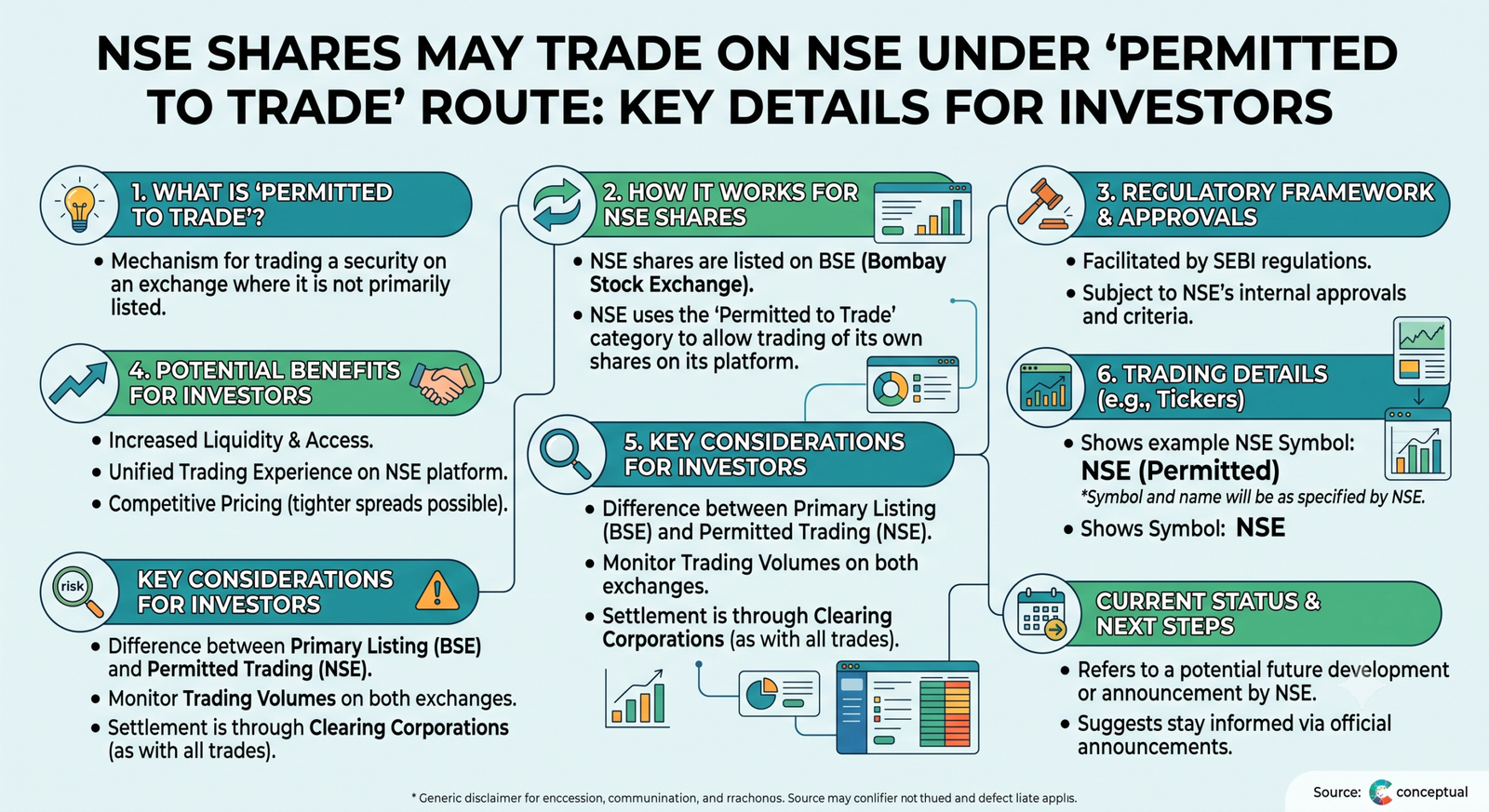
According to reports published on August 20, 2026, NSE is considering using the exchange’s existing “permitted to trade” framework for its shares. Under this structure, a security can trade on an exchange without being formally listed there.
The proposal is particularly important because Indian regulations currently do not allow a stock exchange to formally list its own shares on the same exchange. NSE would therefore need to follow an alternative regulatory route rather than directly self-listing.
What Is the “Permitted to Trade” Framework?
The permitted-to-trade mechanism allows shares that are listed on one recognized exchange to be made available for trading on another exchange without creating a second formal listing.
For example, a company listed on the BSE can, subject to the applicable requirements, have its shares admitted for trading on the NSE. The framework can increase investor access and potentially improve liquidity without requiring the company to maintain a separate formal listing on the second exchange.
NSE currently maintains a dedicated permitted-to-trade category, demonstrating that the mechanism is already part of its market structure.
Why NSE May Want Its Shares Traded on NSE
The proposed arrangement could have several advantages.
1. Greater Liquidity
NSE is India’s largest stock exchange by trading activity in several important market segments. Allowing NSE shares to trade on its own platform could give investors access to an additional pool of liquidity.
More trading venues can also make it easier for investors to enter and exit positions.
2. Better Price Discovery
If NSE shares trade on both BSE and NSE, investors could see prices determined across two major market platforms.
That could create a broader market for NSE shares and potentially improve price discovery.
3. Potential Index Eligibility
Another important issue is index inclusion.
NSE changed its index eligibility framework in 2019 to allow certain securities admitted under the permitted-to-trade mechanism to qualify for consideration in its indices.
This could eventually become relevant for NSE itself, although index inclusion would depend on meeting the applicable rules and approvals.
NSE Would Still Need a Formal Listing Elsewhere
The key distinction is between listing and trading permission.
NSE cannot simply list its own shares on the NSE under the current regulatory framework. Instead, the expected structure is that NSE shares would formally list on another recognized exchange—most notably BSE—and potentially receive permission to trade on NSE.
This approach has precedent. NSE already allows numerous securities that are formally listed elsewhere to trade on its platform under the permitted-to-trade category. NSE’s own securities information page currently provides a separate category for such instruments.
What This Means for the NSE IPO
The proposed trading arrangement is closely linked to NSE’s long-awaited public-market debut.
Reports indicate that NSE is preparing for an IPO and has been targeting a launch in the second half of September 2026, subject to regulatory approvals. The exchange is also seeking approval from the Securities and Exchange Board of India (SEBI).
The IPO is expected to attract significant investor attention because NSE occupies a central position in India’s equity and derivatives markets.
Recent reports have placed potential NSE valuation expectations at up to approximately ₹5.26 lakh crore, although the final IPO valuation, price band, and issue structure could differ from early estimates.
Why the Development Matters for BSE
There is also a competitive angle.
If NSE shares ultimately trade on both exchanges, BSE could become the formal listing venue while NSE could capture trading activity in the stock through its own platform.
This possibility was reflected in BSE’s market movement on August 20, when its shares came under pressure after reports about NSE potentially trading its own shares on the NSE platform.
For BSE, the development highlights an interesting market dynamic: one exchange could provide the formal listing venue while its larger rival could potentially become an important secondary trading venue.
Could NSE Shares Become Part of Nifty Indices?
This is one of the most interesting questions for investors.
The permitted-to-trade framework does not automatically guarantee index inclusion. However, NSE’s rules have previously been adjusted to accommodate securities that trade under this category.
Therefore, if NSE shares satisfy all relevant eligibility conditions after listing, the possibility of eventual inclusion in an NSE benchmark index could become an important consideration.
Such inclusion could increase visibility and potentially create additional demand from funds and other investors that track benchmark indices.
What Investors Should Watch
The NSE story is still developing, and investors should distinguish between confirmed developments and proposals under consideration.
The most important factors to watch are
SEBI approval: The regulatory decision will determine whether NSE can use the proposed structure.
IPO timetable: Investors will be watching for confirmation of the IPO launch window, issue size, price band, and valuation.
Listing venue: BSE is expected to play the formal listing role if the proposed structure goes ahead.
NSE trading approval: Permission to trade NSE shares on the NSE platform would be a separate and highly significant development.
Index eligibility: Investors will want to know whether NSE shares can eventually qualify for inclusion in major benchmarks.
Bigger Picture: Why This Could Be Important for Indian Markets
The potential NSE listing is more than another IPO story.
It could create a rare market structure in which an exchange’s shares are formally listed on one exchange while simultaneously being traded on its own platform through the permitted-to-trade framework.
That could provide an important test of how India’s regulatory system handles market infrastructure institutions entering the public markets while maintaining safeguards around conflicts of interest and market integrity.
It could also make NSE itself a directly investable story for the wider public, giving investors an opportunity to participate in the economics of one of India’s most important financial-market institutions.
Bottom Line
NSE’s possible use of the permitted-to-trade route could solve a practical regulatory challenge surrounding its upcoming public listing.
Rather than formally listing NSE shares on NSE—which is not currently permitted—the exchange could potentially list its shares on BSE and then seek permission for those shares to trade on the NSE platform.
For investors, the key attraction would be potentially greater liquidity, broader price discovery, and the possibility of greater market visibility. However, the proposal remains dependent on regulatory and procedural developments.
The NSE IPO could therefore become one of the most closely watched events in India’s capital markets in 2026.
Disclaimer: This article is for informational and educational purposes only and does not constitute investment advice. Investors should independently evaluate the IPO documents, regulatory disclosures, valuation, and risks before making any investment decision.
Sources: Reports published on August 20, 2026, and NSE’s securities/trading framework information.