




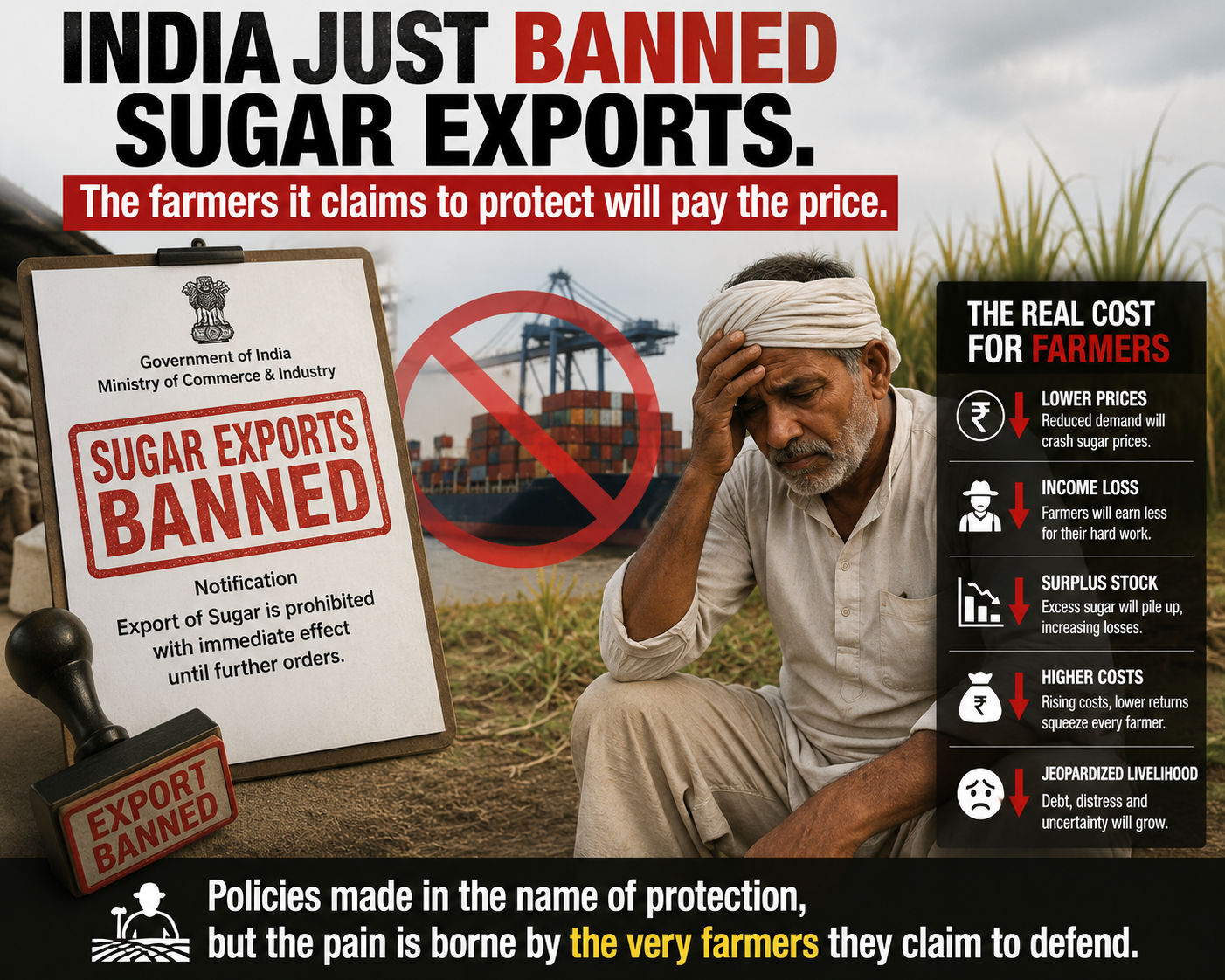
Yesterday, the government issued a gazette notification banning all raw, white, and refined sugar exports with immediate effect—until September 30, 2026. Markets jumped. Brazil celebrated. And 50 million Indian sugarcane farmers got quietly squeezed.
Here is the part the press release does not say out loud:
The Setup: A Government-Made Mess
In February 2026, the government approved 1.59 million metric tons for export and actively encouraged mills and traders to sign contracts. Three months later—mid-season, mid-contract—the ban lands. This is not risk management. This is policy whiplash.
“The government had provided additional export quotas in February, which encouraged traders to sign export deals. It will now be a headache for traders to fulfill those export orders.” — Mumbai trader, Reuters
The Numbers They Are Not Showing You
35M+
tonnes India projected to produce in 2025-26—vs. ~29M consumed
4.7Mt
global surplus forecast by USDA just weeks before the ban
2%
average annual sugar price inflation in India over the last decade
Winners and Losers—Be Honest About It
🏆 Surprise Winners
- 🇧🇷 Brazil — captures India’s buyers
- 🇹🇭 Thailand — fills Asian demand
- Sugar commodity traders short India
- Global sugar futures (↑3% London)
📉 Actual Losers
- Indian sugarcane farmers (arrears)
- Sugar mills (stranded stock, debt)
- Export traders (broken contracts)
- India’s long-term trade credibility
The Elephant in the Room: Ethanol Contradiction
India has a parallel policy diverting sugarcane to ethanol blending. In 2025-26, only 28% of the ethanol allocation used sugar-based feedstock. Which means the government reduced the sugar supply via ethanol diversion—and then cited sugar supply concerns to ban exports. You cannot manufacture a shortage and then congratulate yourself for managing it.
Every time India bans sugar exports, it pays Brazil with permanent market share in exchange for temporary political cover.
The Real Question Nobody Is Asking
- Why does India still have no transparent, rules-based trigger for export restrictions—after three ban cycles in three years?
- Why do Maharashtra and Karnataka cane yields still collapse every bad monsoon when micro-irrigation investment has been promised for a decade?
- Why is the government handing long-term contracts to Brazilian mills on behalf of Indonesian and Bangladeshi buyers—for free?
- If the goal is food security, why are sugar mills — not the government — absorbing the financial risk of unpredictable policy shifts?
The honest take: This is not food security policy. This is electoral optics policy—ban exports, claim you are protecting the aam aadmi, and hope no one notices the mill arrears piling up in Kolhapur and Solapur. India cannot be a global agricultural power if it treats its export commitments as optional. Credibility, once lost to Brazil’s and Thailand’s buyers, takes years to rebuild.
The sugar industry generates rural livelihoods at a scale most urban policymakers cannot comprehend. The solution to monsoon-driven yield volatility is not a gazette notification. It is an investment in irrigation, price-discovery mechanisms, and a multi-year export policy framework that traders and farmers can plan around.
Until then, expect this cycle to repeat — good monsoon, export rush, bad monsoon, export ban, repeat — while Brazil quietly becomes the world’s indispensable sugar supplier. 🇧🇷