








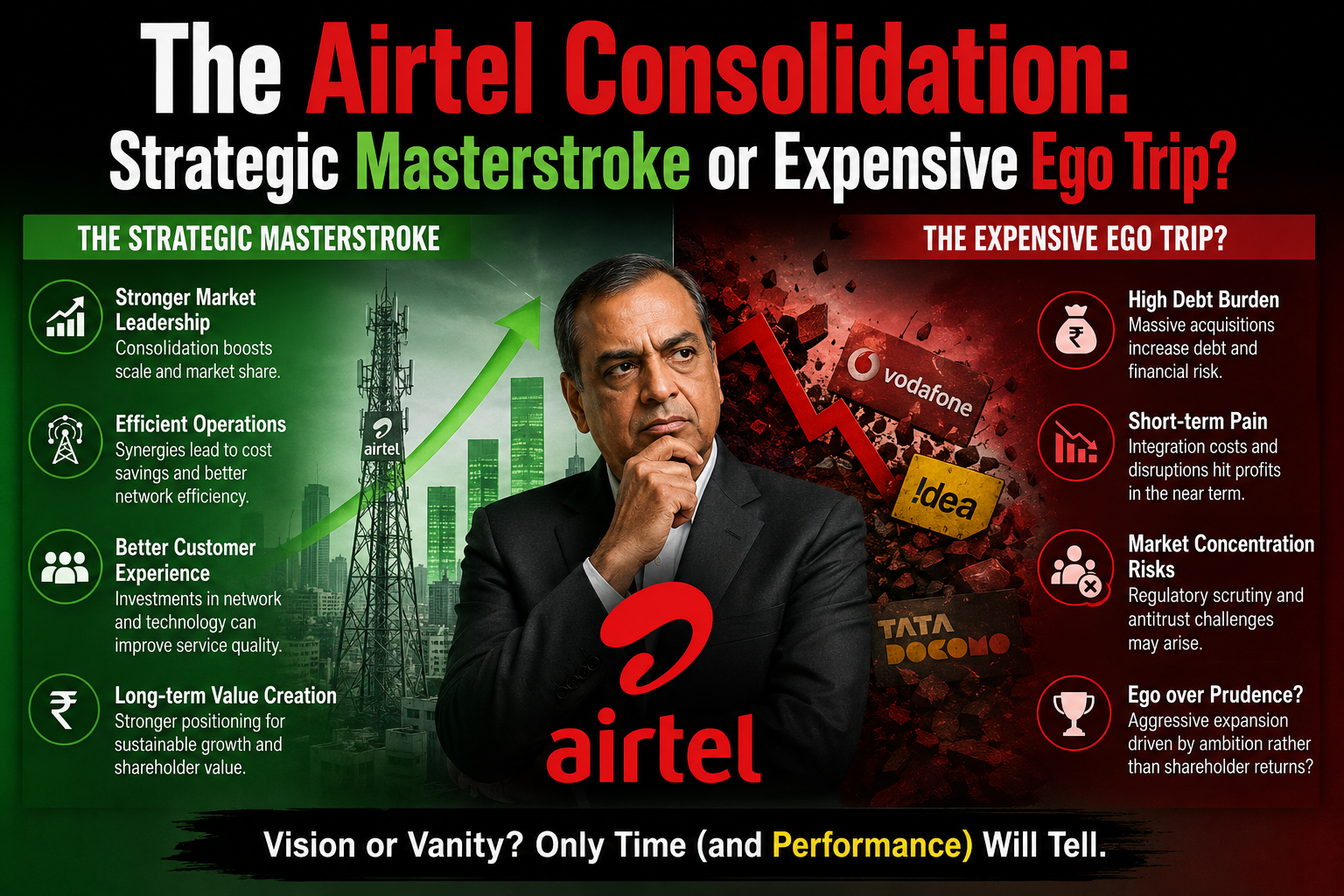
Sunil Mittal is making a move to “bring Airtel home.” The headlines are buzzing with the news that Bharti Telecom is on track to regain a majority stake (over 50%) in Bharti Airtel as long-time partner Singtel steps back toward an “equalized” position.
On paper, it looks like a classic vote of confidence. When a promoter buys back their own company, it usually means they believe the stock is undervalued. But if you look at the timing, the debt, and the opportunity costs, a different picture emerges.
1. Buying at the Top: The Valuation Trap
Airtel’s stock is currently hovering near all-time highs, fueled by recent tariff hikes and a cooling 5G capex cycle. If this was a purely financial move to “capture value,” why didn’t it happen three years ago when the stock was half its current price?
By increasing stakes now, the Bharti Group is committing massive amounts of capital at peak valuations. For a retail investor, “buying high” is a red flag. For a promoter, it raises the question: Is this about shareholder returns, or is it about tightening control at a time when the telecom industry is entering a “comfortable” duopoly?
2. The Debt Shadow
Bharti Airtel is already carrying a massive debt load—roughly ₹2.2 trillion as of early 2024. While the stake purchase is happening at the holding company level (Bharti Telecom), the capital used to buy out Singtel has to come from somewhere.
Often, these maneuvers involve taking on fresh leverage or liquidating other assets. In a high-interest-rate environment, the “cost of control” is high. If the group becomes too focused on equity engineering and debt servicing at the promoter level, it could limit the agility of the operating company (Airtel) to pivot if a new technological disruptor (like satellite internet) emerges.
3. The “Singtel Signal”: What do they know?
Singtel has been Airtel’s “fair-weather and foul-weather” friend for over two decades. They aren’t just an investor; they are a strategic telecom giant. If Singtel is “optimizing its portfolio” and selling down its stake in what Mittal calls the “jewel in the crown,” we have to ask why.
Singtel is pivoting toward digital infrastructure and 5G in other markets. Their exit from a majority position suggests they might see Airtel as a “mature” utility rather than a high-growth tech play. When the smartest guy in the room starts heading for the exit, you don’t necessarily celebrate by buying his seat.
4. Governance vs. Control
For years, the balance of power between the Mittal family and Singtel provided a level of checks and balances. Singtel’s presence ensured that Airtel operated with a global, professional standard of governance.
As the Mittal family moves toward absolute control (over 50%), that balance shifts. While Sunil Mittal is a legendary operator, history shows that when a single family gains “unchallengeable” control over a massive utility, the company can sometimes become less responsive to minority shareholder concerns and more focused on “legacy” and “empire-building.”
The Bottom Line
The “Regain 50%” narrative is great for nationalistic sentiment and promoter optics. It signals that the Indian promoter is back in the driver’s seat.
But for the cold-blooded investor, the move looks expensive, debt-heavy, and potentially defensive. Instead of cheering the consolidation, we should be asking, “Is this the best use of capital in a rapidly evolving digital economy, or is it simply an expensive way to ensure the Mittal name stays at the top of the masthead?”
Sometimes, a “vote of confidence” from a promoter is actually a sign that the company is out of ideas for where else to put its money.
What do you think? Is Mittal’s move a masterclass in timing, or is Singtel the one making the right move by cashing out? Let us know in the comments.