





If you have scrolled through the news recently, you might have seen alarming headlines suggesting that free Unified Payments Interface (UPI) transactions in India are coming to an end.
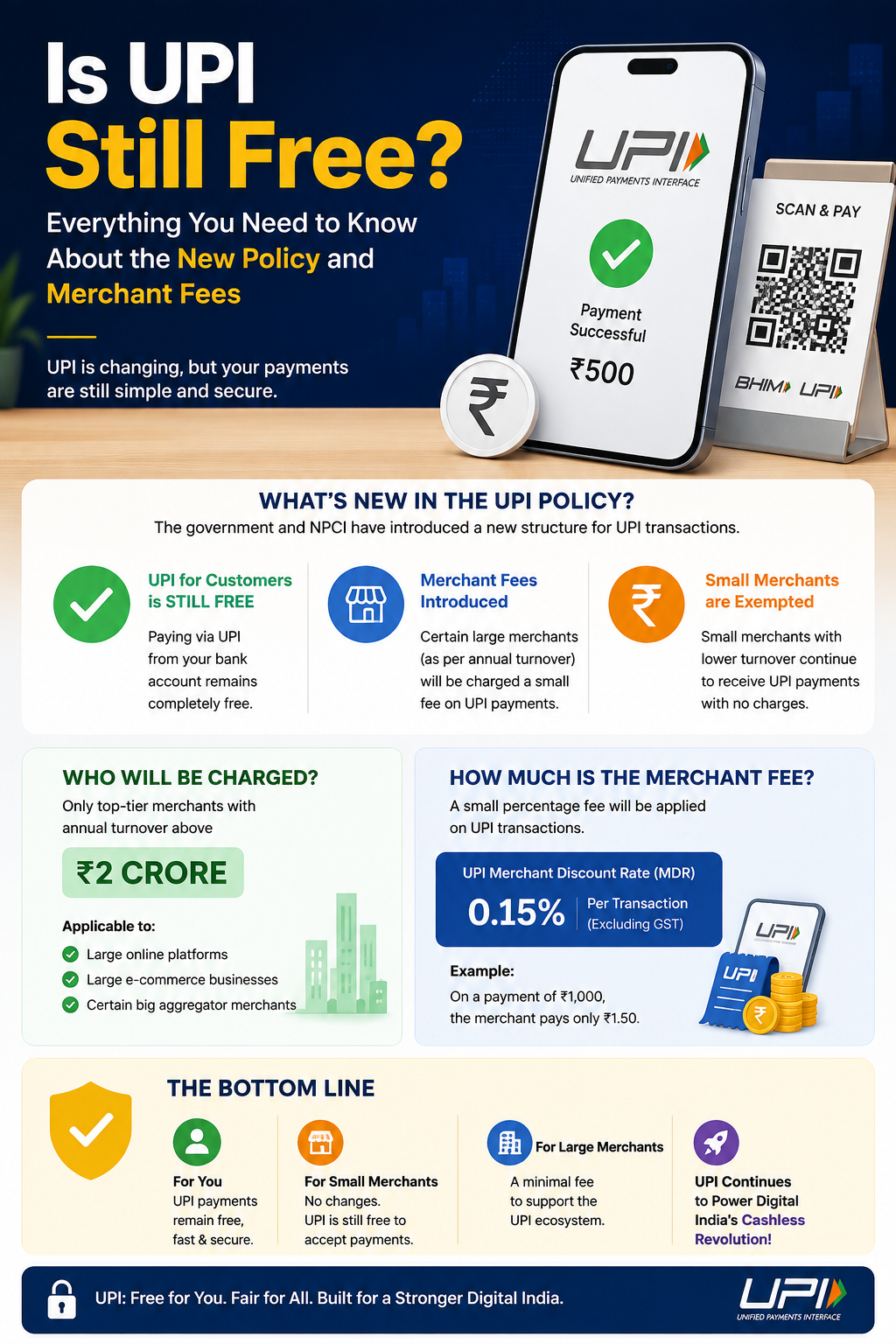
The short answer? No, everyday consumers will not be charged for making UPI payments.
To clear up growing confusion among the public, Finance Minister Nirmala Sitharaman clarified that UPI transactions remain completely free for end-users. The upcoming changes surround the Merchant Discount Rate (MDR), which applies exclusively to merchants—not everyday shoppers or individuals transferring money to friends and family.
Here is a breakdown of what the government’s latest policy change actually means, why it is happening, and how it impacts consumers, merchants, and the fintech ecosystem.
Key Takeaways at a Glance
- For Everyday Users: Zero fees. Person-to-Person (P2P) transfers and small everyday merchant payments remain entirely free.
- For Merchants: Large commercial businesses may soon see a nominal Merchant Discount Rate (MDR) reintroduced on high-value digital transactions.
- The Legal Shift: The passage of the Taxation and Other Laws (Amendment) Bill amends Section 10A of the Payment and Settlement Systems Act, 2007, replacing the fixed zero-MDR rule with flexible government notification powers.
- The Business Impact: Reintroducing merchant fees provides banks and fintech firms (like Paytm, PhonePe, and Google Pay) with a sustainable revenue model to invest in server infrastructure, fraud prevention, and security.
What Did the Finance Minister Clarify?
Addressing concerns raised over legislative amendments, Finance Minister Nirmala Sitharaman stated firmly that the Merchant Discount Rate applies strictly to businesses and merchants, never to individual consumers.
“Merchant Discount Rate (MDR) applies only to the merchants and not to the end users/customers. It will support the banks & fintechs to invest more in infrastructure, innovation & security.”
— Nirmala Sitharaman, Union Finance Minister
Furthermore, the exact rates and framework are not set in stone yet. The UPI and Services Steering Committee, led by the National Payments Corporation of India (NPCI), will determine the final fee structure following full parliamentary procedures.
What is MDR, and why was zero-MDR implemented?
What is MDR?
Merchant Discount Rate (MDR) is the processing fee charged to a merchant by payment service providers (banks, card networks, and payment gateways) for processing digital transactions. When you pay a merchant via credit card, for example, the store owner typically pays a fee between 1% and 3% to cover transaction processing and network maintenance.
The Zero-MDR Policy
In January 2020, the Indian government abolished MDR on RuPay debit cards and UPI transactions to accelerate digital payment adoption across the country.
While the policy was immensely successful—making India a global leader in real-time digital payments—it left banks, third-party payment apps, and fintech firms bearing billions of rupees in operational costs without direct transaction revenue.
Why Is the Policy Changing Now?
Processing billions of UPI transactions every month requires heavy infrastructure, high-capacity servers, real-time fraud monitoring, and 24/7 customer support.
Industry reports indicate that government subsidies for digital payments covered only a small fraction of the actual operational costs incurred by payment service providers. Reintroducing a modest MDR for large merchants addresses key industry challenges:
- System Reliability & Scalability: Financial institutions need capital to upgrade network backbones and prevent transaction failures during high-peak traffic.
- Enhanced Cybersecurity: As digital payment volume grows, fighting sophisticated financial fraud requires continuous technology investments.
- Fintech Sustainability: Allowing payment service providers to capture revenue ensures that domestic fintech companies remain financially viable and innovative.
Who Will Actually Pay the Fee?
The proposed framework is designed to protect small vendor ecosystems and everyday retail buyers.
| Transaction Type | Proposed Status | Expected Cost |
| Person-to-Person (P2P) | Always Free | ₹0 |
| Small Merchants / Kirana Stores | Free / Exempt | ₹0 |
| Small Payments (Under ₹2,000) | Free / Exempt | ₹0 |
| Large Merchants / E-Commerce | Nominal MDR | Estimated 0.05% to 0.3% |
The Bottom Line
The move to end the blanket zero-MDR mandate is a transition from an initial growth phase (funded by state subsidies and corporate cash burn) to a sustainable long-term ecosystem.
For the average Indian consumer scanning a QR code at a local store or sending money to family, UPI remains as free and fast as ever. For the broader economy, the policy provides the financial foundation needed to keep India’s digital payment grid secure, reliable, and world-class.