







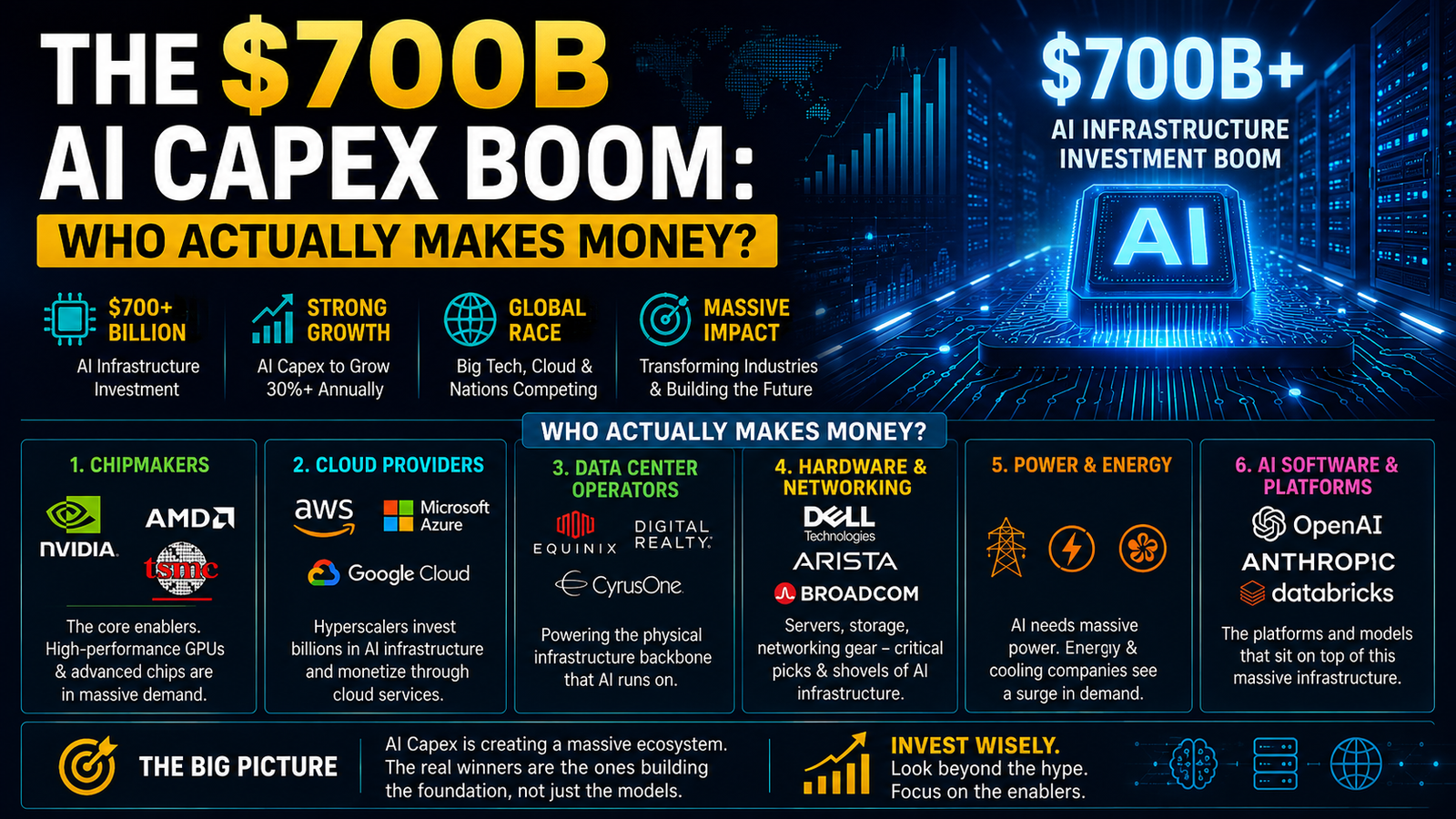
One important framing point: the “$700B” figure is best treated as the 2026 capital-spending commitment of the four largest U.S. hyperscalers—Amazon, Microsoft, Alphabet, and Meta—not as a pure AI-only capex number. Much of that spending is AI-related, but it also includes broader cloud, networking, servers, data centers, and other infrastructure. Using their latest disclosed 2026 ranges/guidance, the midpoint is roughly $707.5 billion. Amazon alone expects about $200B, Microsoft about $190B, Alphabet $175–185B, and Meta $130–145B.
The bigger question for investors is not “Will AI grow?”
It is:
Where does the economic value accrue as hundreds of billions of dollars move through the AI infrastructure supply chain?
The AI investment cycle has entered a new phase.
In 2023, the market debated whether generative AI was a technological breakthrough. In 2024, investors focused on GPUs. In 2025, the conversation shifted toward data centers and AI infrastructure.
By 2026, the question has become much larger:
Who captures the profits from the largest technology infrastructure buildout in decades?
Amazon expects to spend about $200 billion on capital expenditures in 2026. Microsoft expects roughly $190 billion, Alphabet expects $175–185 billion, and Meta expects $130–145 billion. At the midpoints, the four companies alone are targeting approximately $707.5 billion of capital investment.
And this is only the visible hyperscaler layer.
Oracle has separately guided to $50 billion of FY2026 capex, while the broader AI infrastructure ecosystem includes semiconductor companies, foundries, memory manufacturers, networking vendors, power-management suppliers, cooling companies, construction firms, and data-center operators.
The result is an extraordinary investment chain:
Cloud companies → data centers → servers → GPUs/accelerators → HBM → networking → power → cooling → construction → electricity generation → software → AI applications.
The crucial investment insight is that not every layer has the same economics.
Some companies are spending billions.
Others are selling the tools required to enable the spending.
That distinction matters.
1. The hyperscalers are the buyers.
Amazon, Microsoft, Alphabet, and Meta sit at the top of the spending chain.
Amazon’s CEO Andy Jassy said the company expects roughly $200 billion of 2026 capex, driven by opportunities including AI, chips, robotics, and other businesses, with the bulk of the AI-related investment flowing through AWS. Amazon’s trailing free cash flow had already fallen sharply as property and equipment spending surged, illustrating the basic economics of the boom: cash is being converted into infrastructure before the full return appears in earnings.
Microsoft is committing at an extraordinary scale as Azure demand exceeds available supply. In its latest disclosed calendar-year outlook, Microsoft said it expects to invest approximately $190 billion in 2026 capex and remain constrained through 2026. Roughly two-thirds of recent quarterly capex has been directed toward short-lived assets, primarily GPUs and CPUs.
Alphabet expects $175–185 billion of 2026 capex. Around 60% of its technical infrastructure spending has historically gone toward servers, with the remainder going into data centers and networking.
Meta expects $130–145 billion of 2026 capital expenditures, including finance leases, after raising its previous forecast.
Put together, this is a capital-spending machine of unprecedented scale.
But the hyperscalers do not automatically become the biggest beneficiaries.
They are investing capital because they expect other companies and consumers to pay them back through cloud services, advertising productivity, subscriptions, and AI applications.
That means investors need to look one layer deeper.
2. Nvidia is the obvious toll collector.
The clearest winner so far is Nvidia.
Nvidia reported $81.6 billion of quarterly revenue in its fiscal Q1 2027, up 85% year over year.
More important: Data Center revenue reached $75.2 billion, up 92% year over year. Gross margin was approximately 75%.
That tells us something important about the AI economy.
Hyperscalers are spending hundreds of billions of dollars.
A meaningful percentage of that money immediately flows toward accelerated computing.
Nvidia sells the GPUs, networking, systems, and increasingly the software ecosystem surrounding those deployments.
This is why AI infrastructure is different from many traditional capital-spending cycles.
A factory spending $10 billion on equipment doesn’t necessarily create a $10 billion revenue opportunity for one equipment supplier.
AI infrastructure can create a recurring demand loop:
More AI usage → more compute → more GPUs → more data centers → more networking → more power → more AI applications → more AI usage.
That flywheel is what investors are betting on.
But Nvidia’s position isn’t risk-free.
The industry is moving toward custom accelerators, cloud providers are designing their own chips, and competition in AI inference may eventually put pressure on hardware economics.
That leads us to the second major beneficiary.
3. Broadcom: the custom-chip thesis
Broadcom is one of the most important companies in the AI infrastructure chain because the AI industry isn’t simply buying Nvidia GPUs.
Hyperscalers increasingly want customized silicon optimized for their specific workloads.
Broadcom’s Q2 FY2026 AI semiconductor revenue was $10.8 billion, up 143% year over year. Management expected AI semiconductor revenue to reach $16 billion in Q3, implying growth of more than 200% year over year.
This is potentially one of the most important second-order trends in AI.
The first phase of the AI buildout was dominated by general-purpose accelerated computing.
The next phase is increasingly about optimization.
Cloud providers want:
- lower cost per token;
- better energy efficiency;
- higher utilization;
- specialized inference;
- tighter integration between compute, memory, and networking.
That creates an enormous market for custom accelerators.
The implication is straightforward:
Nvidia does not need to win every AI chip dollar for the AI semiconductor market to continue expanding.
The total pool can grow even while the competitive landscape becomes more diverse.
4. Memory is becoming strategically important
The AI industry’s limiting factor is no longer simply compute.
It is increasingly memory bandwidth and capacity.
AI accelerators require high-bandwidth memory, or HBM, to move enormous quantities of data quickly.
That makes memory manufacturers strategically important.
Micron’s fiscal Q3 2026 results demonstrated the scale of this cycle, with quarterly revenue reaching $41.46 billion, compared with $9.30 billion a year earlier. Micron described the results as evidence of the strategic value of memory in the AI era.
This matters because every generation of AI infrastructure requires more sophisticated memory architectures.
The investment thesis is therefore broader than
GPU shortage → Nvidia wins.
It is becoming:
AI compute growth → GPUs + custom accelerators + HBM + advanced packaging + networking.
5. Advanced packaging is an invisible bottleneck.
One of the most overlooked areas of the AI supply chain is advanced semiconductor packaging.
Modern accelerators are increasingly complex systems made from GPUs, HBM stacks, chiplets, and high-speed interconnects.
Applied Materials explicitly says AI growth is driving demand across leading-edge logic, DRAM and advanced packaging. The company now expects its semiconductor equipment business to grow more than 30% in calendar 2026.
This demonstrates an important principle:
When the end market booms, the companies selling the manufacturing equipment can benefit before the final chips reach customers.
The same logic applies across the semiconductor equipment chain.
The AI trade therefore extends from the chip designer to the companies that manufacture and package the chips.
6. Networking is the next major profit pool.
AI clusters don’t work like traditional data centers.
Thousands—or eventually hundreds of thousands—of accelerators need to communicate with one another at extremely high speeds.
That makes networking infrastructure critical.
Arista Networks generated approximately $9 billion of revenue in 2025, while its Q4 revenue rose 28.9% year over year. The company has positioned AI networking as a major growth opportunity.
Cisco provides another example.
Cisco recently reported $9.3 billion of AI infrastructure orders for fiscal 2026, including $4 billion in its fourth quarter alone from hyperscalers, and expects $7.5 billion of AI infrastructure revenue in fiscal 2027.
This is why networking deserves more attention.
The market initially treated AI infrastructure as a GPU story.
But the architecture is becoming:
GPU + HBM + networking + storage + power + cooling.
As models become more distributed and AI clusters become larger, the data movement problem becomes increasingly important.
7. The real sleeper: power and cooling
The next constraint may not be silicon.
It may be electricity.
The International Energy Agency estimates global data-center electricity consumption will more than double to approximately 945 TWh by 2030. AI-accelerated servers are expected to grow electricity consumption at about 30% annually, making them one of the largest contributors to incremental data-center power demand.
This changes the investment map.
AI isn’t just a technology story.
It is an energy infrastructure story.
Data centers require:
- transformers;
- switchgear;
- UPS systems;
- power distribution;
- generators;
- cooling;
- transmission;
- substations;
- grid connections.
Vertiv is already showing what this can mean financially.
In Q2 2026, Vertiv’s sales increased 24% year over year to $3.274 billion, while the company raised its full-year guidance and projected approximately 31% organic sales growth for 2026.
Schneider Electric has likewise reported sustained double-digit demand in its data center and networking end market, reflecting continued AI-ready infrastructure deployment.
This is one of the most important shifts in the AI investment thesis.
Power equipment manufacturers could become as strategically important as semiconductor companies.
8. Why the grid may become the ultimate bottleneck
AI data centers increasingly require enormous blocks of electricity.
Schneider Electric has highlighted the growing difficulty of securing grid connections, with some large-load projects facing very long queues.
The IEA expects U.S. data centers to account for nearly half of electricity-demand growth through 2030.
The implication is that AI infrastructure will increasingly compete for:
land + power + transmission + cooling + equipment + financing.
This could change where data centers are built.
Locations with abundant electricity and fast grid connections gain strategic value.
That creates investment opportunities in power generation, transmission, electrical equipment, data center real estate, and infrastructure financing.
9. India could become one of the biggest secondary beneficiaries.
The global AI buildout is increasingly becoming an Indian infrastructure story too.
India’s data center capacity increased from approximately 375 MW in 2020 to around 1,500 MW by 2025, according to India’s Ministry of Electronics and IT. The government says about 38,231 GPUs had been onboarded through its AI compute capacity framework.
CBRE has identified India as one of the key growth markets in Asia-Pacific as AI demand pushes data center development toward locations with better power availability.
More recently, infrastructure investor Brookfield said approximately 6.5 GW of AI data center capacity could come online in India over the next five years.
And on August 13, 2026, Larsen & Toubro announced a potential ₹150 billion ($1.57 billion) contract from Together AI to develop an AI data center in India using Nvidia infrastructure.
This is a major signal.
India’s AI opportunity is not limited to software engineers.
It extends into:
construction + power + transmission + cooling + data centers + networking + semiconductor manufacturing + cloud infrastructure.
10. The AI value chain
The easiest way to think about the ecosystem is as a pyramid.
Layer 1 — AI platforms
Microsoft, Amazon, Google, Meta, Oracle
These companies spend the money.
Layer 2—Accelerated compute
Nvidia, Broadcom, and other accelerator suppliers
These companies sell the engines.
Layer 3 — Memory
Micron and global HBM suppliers
These companies supply the data bandwidth.
Layer 4—Semiconductor manufacturing
TSMC and equipment suppliers such as Applied Materials
These companies build the industrial capacity.
Layer 5 — Networking
Arista, Cisco, and related suppliers
These companies connect the machines.
Layer 6—Power and cooling
Vertiv, Schneider Electric, and other infrastructure suppliers
These companies keep the machines operational.
Layer 7—Energy and grid
Utilities, power producers, transmission companies, and infrastructure developers
These companies provide the electricity.
Layer 8 — AI applications
Enterprise software, cybersecurity, healthcare, finance, industrial automation, and robotics
These companies ultimately determine whether AI produces enough economic value to justify the infrastructure investment.
11. So who actually makes the money?
The answer isn’t simply Nvidia.
The best way to think about the investment opportunity is through pricing power and bottlenecks.
The strongest companies tend to sit where:
- Demand is growing rapidly;
- supply is constrained;
- The product is mission-critical;
- Customers cannot easily switch suppliers;
- The supplier captures recurring revenue or high margins.
That explains why the AI infrastructure trade has expanded from Nvidia into networking, memory, semiconductor equipment, cooling, and power.
12. But there’s a huge risk.
The market is assuming that today’s AI capex will eventually create future cash flows.
That isn’t guaranteed.
The biggest risk is overbuilding.
If hyperscalers build more computing capacity than customers actually use, returns on invested capital will fall.
That could create a painful cycle:
Capex → excess capacity → falling prices → lower margins → slower capex → weaker supplier growth.
The other risk is technological efficiency.
If AI models become dramatically more efficient, the amount of compute needed to generate a given amount of useful output could fall.
But this doesn’t necessarily destroy the AI infrastructure thesis.
Historically, cheaper computing often creates more computing demand.
The question is whether efficiency improvements cause:
lower total compute demand
or
more AI usage at a lower cost.
So far, the industry is behaving much more like the second scenario.
13. The metric investors should watch
The most important metric isn’t AI excitement.
It is:
Revenue generated per dollar of infrastructure investment.
Investors should therefore track:
Capex growth vs. cloud revenue growth
AI infrastructure revenue vs. total infrastructure spending
Gross margins
Free cash flow
Data center utilization
Backlog/RPO
Power availability
GPU lead times
HBM pricing
Networking demand
When cloud revenue starts growing faster than infrastructure spending, the economic model becomes healthier.
When capex grows dramatically faster than monetization, risk increases.
14. The bigger picture
The $700 billion AI capex boom isn’t simply a technology boom.
It is a capital-cycle event.
AI is pulling investment forward across multiple industries simultaneously.
Semiconductors.
Memory.
Networking.
Power.
Construction.
Real estate.
Energy.
Cloud computing.
Industrial automation.
The largest mistake investors can make is looking only at the AI application layer.
The more interesting question is
What physical infrastructure must exist before AI applications can scale?
That is where some of the strongest second-order opportunities may emerge.
And the next phase could be even bigger.
Because once companies finish training frontier models, the world still has to run them.
Inference requires continuous computing.
Agents require continuous computing.
Robotics requires continuous computing.
Autonomous systems require continuous computing.
Enterprise AI requires continuous computing.
That means the AI economy could transition from a training-driven capital cycle into an always-on inference infrastructure cycle.
If that happens, today’s $700 billion may not represent the peak.
It may represent the beginning.
Investment takeaway: don’t just ask which AI company will win.
Ask:
Who sells the chips?
Who supplies the memory?
Who connects the chips?
Who cools them?
Who powers them?
Who owns the data centers?
And who eventually captures the revenue generated by all of that infrastructure?
That is the real AI investment map.
MarketTechGuru note: This is research and market commentary, not personalized investment advice.