






The Big Picture Weekly
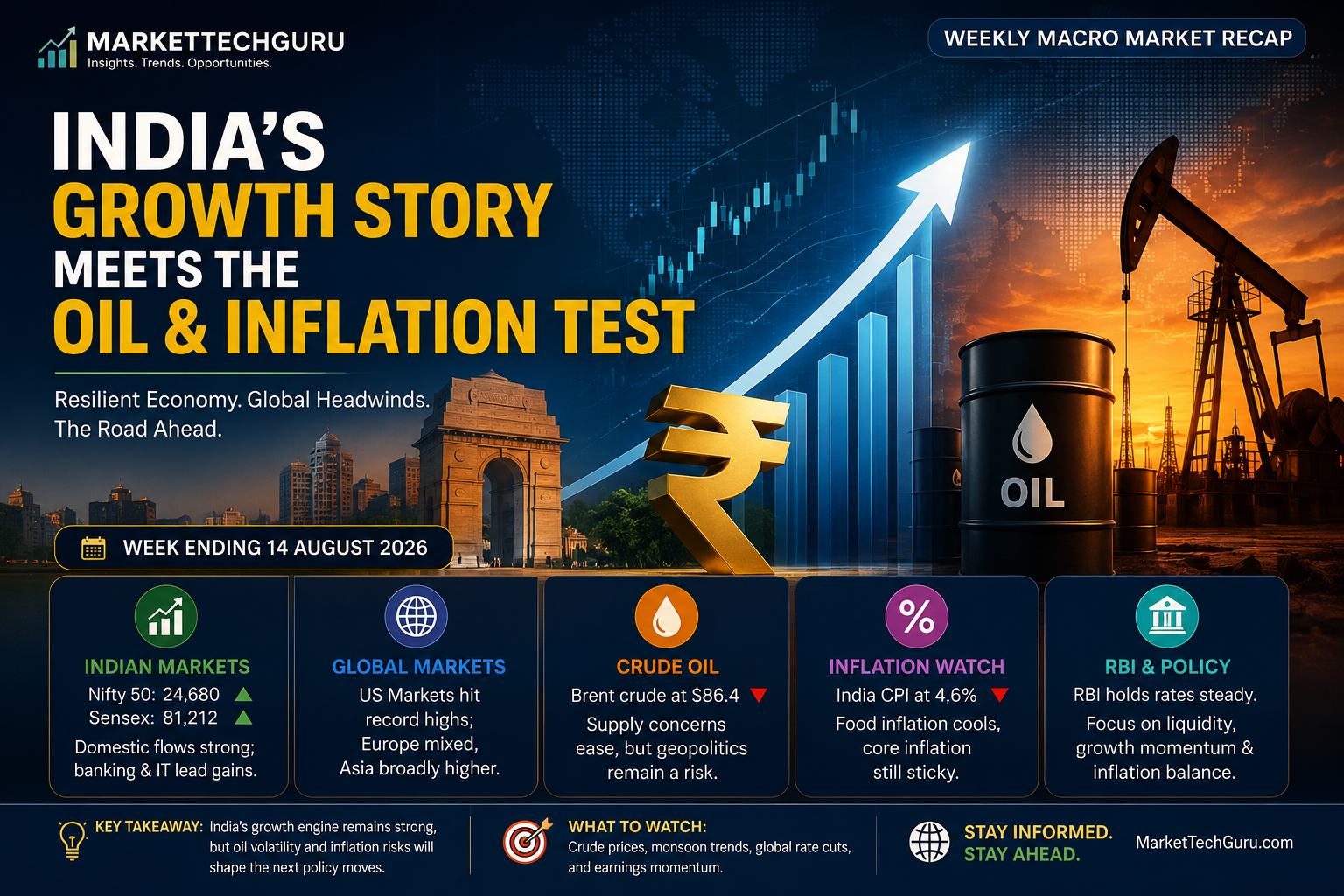
India’s Growth Story Meets the Oil & Inflation Test
Weekly Macro Market Recap | Week Ending 14 August 2026
MarketTechGuru.com
Executive Summary
Indian equities ended the week on a cautious note as rising crude prices, geopolitical uncertainty, and continued foreign-investor pressure offset a generally resilient domestic economic backdrop.
The Nifty 50 fell 0.8% for the week to 24,366, while the Sensex declined 0.6% to 78,009.25. The broader market was more resilient: the Nifty MidCap index gained 0.5%, while the SmallCap index declined 0.7%.
The important point is that the Indian market is not currently facing a classic growth-collapse problem. Instead, investors are dealing with a valuation-versus-macro-risk problem.
India’s industrial economy is still expanding rapidly. June IIP growth accelerated to 7.3%, with manufacturing growing 7.8%, capital-goods output rising 14.2%, and infrastructure/construction goods growing 7.5%. Electrical equipment production grew 34%, and motor vehicle production 17.5%.
But inflation is moving in the opposite direction. India’s July retail inflation accelerated to 4.45%, up from 4.38% in June, putting headline inflation above the RBI’s 4% target for a second consecutive month. Rural inflation was 4.84%, compared with 3.96% in urban India.
The wholesale-price picture is even more striking. June WPI inflation reached 9.87%, its highest level in the new 2022–23-based series. Fuel and power inflation was 27.41%, while manufactured-product inflation remained 7.48%.
The global backdrop is equally complicated.
In the United States, July CPI inflation came in at 3.4% year-on-year, down from 3.5% in June, while core CPI eased to 2.5%. Meanwhile, July payrolls unexpectedly declined by 23,000, and the unemployment rate edged down to 4.1%, although the fall was partly driven by a reduction in labor force participation.
The Federal Reserve nevertheless remains cautious. At its 29 July meeting, the Fed kept the federal funds target at 3.50%–3.75%, while three policymakers preferred a 25-basis-point increase. The Fed said inflation remained elevated relative to its 2% objective and highlighted energy-related supply shocks.
Then there is oil.
Brent crude finished the week around $88.52 per barrel, up about 5.9% over the week, as tensions surrounding the Strait of Hormuz and U.S.-Iran negotiations kept a geopolitical premium embedded in crude.
For India, this is the variable that could determine whether strong growth continues to translate into higher corporate earnings and a sustained equity rally.
The macro message this week is therefore simple:
Growth is holding. Inflation is rising. Oil is becoming the swing factor. Global monetary policy is uncertain.
And that combination argues for a market that remains bullish selectively—but increasingly unforgiving on valuations.
1. Indian Equities: The Market Pauses
The Indian market broke a two-week winning streak this week.
The Nifty 50 declined 0.8% to 24,366, while the Sensex fell 0.6% to 78,009.25. The decline was not a broad collapse. Instead, it reflected a rotation away from riskier parts of the market and increasing sensitivity to external risks.
Financials declined around 1%, metals lost 1.9%, and Reliance Industries dropped 1.9%, partly reflecting an MSCI weight reduction. Tata Motors was among the weakest large-cap names after reporting a sharp drop in quarterly profit.
At the same time, LG Electronics India rallied 9.6% after strong results and a positive full-year revenue outlook. The contrast is important: this is not a market where investors are selling everything indiscriminately.
It is a market in which earnings quality, valuation, and business visibility are increasingly separating winners from losers.
This explains why the broader market has not behaved exactly like the headline indices.
Midcaps gained 0.5% on the week even as the Nifty declined. This divergence suggests that domestic investors remain willing to deploy capital, particularly into companies with strong structural growth stories.
But it also means investors should not interpret index weakness automatically as a broad bear-market signal.
The better description is
India is consolidating while the macro risk premium rises.
2. The Real Indian Story: Industrial Activity Is Strong
One of the most encouraging signals in the current Indian macro picture is industrial production.
June IIP growth accelerated to 7.3% year-on-year, compared with 5.1% in May.
The composition makes the number particularly interesting.
Manufacturing grew 7.8%, while electricity and gas supply expanded 10.6%. Capital goods grew 14.2%, intermediate goods rose 9.3%, and infrastructure/construction goods grew 7.5%. Consumer durables expanded 7.7%.
The strongest manufacturing contributors included electrical equipment, motor vehicles, and food products.
Electrical equipment production grew 34%.
Motor-vehicle production grew 17.5%.
Food-product manufacturing grew 10.8%.
This tells us something more important than the headline IIP number: investment and manufacturing momentum remain alive.
Capital-goods growth is particularly worth watching.
When capital goods expand at a double-digit pace, it generally points toward increasing spending on machinery, equipment, and productive capacity.
India’s medium-term investment cycle therefore remains intact.
The challenge is whether rising input prices eventually compress corporate margins.
That is where inflation enters the story.
3. Inflation Is Back on the Investor Radar
India’s retail inflation accelerated to 4.45% in July.
While 4.45% remains far from a crisis level, the direction matters.
The RBI targets 4% inflation over the medium term, with a tolerance band of 2%–6%. July therefore remains comfortably inside the formal tolerance range—but it is the second straight month above target.
More importantly, rural inflation was 4.84%, significantly above urban inflation at 3.96%.
That distinction matters because rural consumption has been an important part of the domestic growth narrative.
If food and essential prices continue to rise, households may have less discretionary purchasing power.
The risk is not necessarily that Indian consumers stop spending.
The risk is that spending shifts.
More income may go toward food, fuel, and essentials, leaving less available for discretionary consumption.
That could create a divergence between:
India’s overall GDP growth
and
the earnings growth of consumer-facing companies.
The wholesale inflation picture is more uncomfortable.
June WPI inflation reached 9.87%, compared with 9.68% in May. Fuel and power inflation stood at 27.41%, primary articles inflation at 7%, and manufactured-product inflation at 7.48%.
The difference between CPI and WPI highlights a key macro tension.
Consumer inflation is manageable.
Producer and wholesale price pressures are much stronger.
That creates the possibility of a margin squeeze.
If companies cannot fully pass higher input costs to consumers, earnings estimates may eventually come under pressure.
4. The Oil Problem: India’s Biggest Macro Variable
This week’s most important external variable may not have been the Federal Reserve.
It was crude oil.
Brent ended the week around $88.52 per barrel after rising nearly 6% over the week. Geopolitical uncertainty around Iran, the Strait of Hormuz, and the possibility of prolonged disruptions have kept traders focused on supply risk.
India is especially sensitive to crude because it remains heavily dependent on imported energy.
Higher crude prices can affect India through several channels:
First, the trade deficit can widen.
Second, inflation can rise.
Third, the rupee can come under pressure.
Fourth, corporate input costs can increase.
Fifth, transport and logistics costs can rise.
Sixth, household disposable income can be squeezed.
And finally, the RBI’s room to ease monetary policy becomes smaller.
This is why crude around $90 is much more important to India than a single percentage-point move in an overseas index.
The market can absorb temporary geopolitical headlines.
It struggles more when those headlines create a persistent increase in the cost of energy.
The next few weeks, therefore, require investors to watch oil almost as closely as they watch the Nifty and Sensex.
5. The RBI: Growth Support vs. Inflation Discipline
The RBI’s current policy rate is 5.25%, with the Standing Deposit Facility at 5.00% and the Marginal Standing Facility/Bank Rate at 5.50%.
The interesting question is no longer simply whether the RBI can cut rates.
The more important question is
Does it need to?
India’s industrial activity is strong.
Growth momentum is solid.
But inflation is moving higher, wholesale prices are elevated, and crude is rising.
That creates a difficult policy equation.
A central bank can support growth by lowering rates.
But if inflation is simultaneously moving above target and imported energy prices are rising, aggressive easing becomes more difficult.
For Indian equities, that creates an important implication.
A stable policy environment may actually be more constructive than a rapid easing cycle if it helps stabilize inflation expectations and the currency.
The market, therefore, should not automatically treat every pause in rate cuts as negative.
Sometimes the absence of monetary tightening is enough.
6. The United States: The Fed Is Caught Between Inflation and Employment
The American macro picture is becoming increasingly two-sided.
July CPI rose 3.4% year-on-year, down from 3.5% in June. Core CPI was 2.5%. These figures show that inflation is cooling gradually but remains above the Federal Reserve’s 2% target.
The labor market, however, has weakened.
The U.S. economy unexpectedly lost 23,000 jobs in July. Previous job gains were also revised lower, while the unemployment rate fell to 4.1%.
But the unemployment-rate decline was not entirely reassuring because labor force participation dropped to 61.4%.
This is why markets reduced expectations of a September rate hike.
But investors should not confuse softer employment with an automatic return to easy money.
The Fed itself remains concerned about inflation.
At its July meeting, the central bank held rates at 3.50%–3.75%. Three officials dissented in favor of a 25-basis-point hike. The Fed also explicitly referenced energy-related supply shocks as an inflation risk.
That creates a difficult scenario for global markets.
If inflation remains sticky, rates may stay high.
If employment weakens materially, growth concerns may rise.
If oil remains elevated, both problems can occur simultaneously.
This is why the next U.S. macro cycle may be defined by stagflation risk rather than simple disinflation.
7. U.S. Bonds Matter for Indian Equities
Another variable investors should watch is the U.S. 10-year Treasury yield.
The 10-year yield ended the week near 4.7%, while geopolitical concerns pushed oil higher.
Higher Treasury yields matter because they influence global capital allocation.
When U.S. bonds provide attractive risk-adjusted returns, emerging-market equities have to compete harder for capital.
India can still attract investment because of its growth prospects.
But valuation matters.
A highly valued Indian stock needs a much stronger earnings outlook when global bond yields are high than it would when global rates are collapsing.
That is one reason why Indian investors should focus increasingly on earnings growth relative to valuation, rather than looking only at absolute market momentum.
8. What the Market Is Really Pricing
The biggest misconception would be to describe this market simply as bullish or bearish.
It is neither.
The market is pricing several competing narratives at the same time.
One narrative says India has strong domestic growth, resilient industrial activity, and structural investment opportunities.
Another says oil prices are rising and could reignite inflation.
A third says U.S. employment is weakening and the Fed may have less reason to hike.
A fourth says U.S. inflation remains too high for aggressive monetary easing.
A fifth says geopolitical risk could stay elevated for longer.
Put those together and you get a market that is likely to remain volatile inside a broad consolidation regime.
That is also why stock selection could become more important than index direction.
9. Sector Outlook
Financials
Financials remain central to India’s domestic-growth story, but investors should distinguish between high-quality private banks and weaker franchises.
With credit growth and investment activity still healthy, financials remain structurally supported. However, rising funding costs and macro uncertainty can create short-term volatility.
Industrials and Capital Goods
This is one of the most interesting parts of the market.
Capital-goods production grew 14.2% in June.
If private and public investment remains strong, industrials, engineering companies, infrastructure players, and manufacturing supply chains could continue to benefit.
Autos
Auto remains a powerful cyclical indicator, but this week’s Tata Motors weakness demonstrates that strong sector-level narratives do not protect companies from earnings disappointments.
The market is increasingly rewarding execution rather than simply sector exposure.
Metals
Metals remain exposed to global growth, China, and commodity prices.
The sector’s 1.9% weekly decline underlines how sensitive it is to the global growth and commodity cycle.
Consumer
The consumer story is constructive but deserves closer monitoring.
Rural inflation at 4.84% is an important warning signal.
If food inflation remains elevated, consumer discretionary growth could become uneven.
Energy
Energy is becoming strategically more important.
Higher crude prices support upstream companies, but they create costs elsewhere in the economy.
For investors, the energy trade needs to be viewed through both sides of the ledger.
10. The Most Important Numbers This Week
Nifty 50: 24,366, down 0.8% for the week.
Sensex: 78,009, down 0.6%.
India CPI: 4.45% in July.
India WPI: 9.87% in June.
India IIP: 7.3% in June.
U.S. CPI: 3.4% in July.
U.S. core CPI: 2.5%.
U.S. July payrolls: -23,000.
U.S. unemployment: 4.1%.
Fed funds target: 3.50%–3.75%.
Brent crude: about $88.52/bbl at the end of the week.
11. What Investors Should Watch Next
The coming weeks could be more important than the past one.
First, watch crude.
The $90 area is psychologically and economically important for India. A sustained move materially above that level would increase the probability of renewed inflation pressure.
Second, watch the rupee.
Oil plus higher U.S. yields creates a difficult combination for emerging-market currencies.
Third, watch corporate earnings.
The next phase of the market may be less about revenue growth and more about whether companies can protect margins.
Fourth, watch India’s inflation data.
The direction of food and fuel inflation will determine how much monetary-policy flexibility the RBI has.
Fifth, watch U.S. labor data.
The combination of weak employment and sticky inflation will be crucial for the Fed.
Finally, watch India’s GDP on 31 August.
The official Q1 FY27 GDP release is scheduled for that date. Until then, investors should use high-frequency indicators such as IIP, consumption, credit, and infrastructure activity rather than assume a final GDP number.
The Big Picture
The Indian economy is not breaking.
But the market is being asked to prove that earnings can keep growing while the world becomes more expensive.
That distinction matters.
India enters the second half of 2026 with several powerful structural advantages: strong industrial activity, investment spending, domestic demand, and long-term manufacturing potential.
But the external environment has become less forgiving.
Oil is rising.
Wholesale inflation is elevated.
The rupee faces external pressure.
U.S. rates remain restrictive.
Geopolitical risk remains high.
And valuations leave limited room for disappointment in many parts of the market.
Therefore, the investment message for the coming weeks is not to become aggressively bearish.
It is to become more selective.
The next leg of the Indian equity story will likely require three things:
strong earnings, manageable inflation, and stable global liquidity.
If those three align, Nifty can eventually move beyond consolidation and resume its broader structural uptrend.
If oil remains elevated while inflation rises and global yields stay high, the market may spend more time moving sideways.
That is why the most important market chart right now may not be Nifty.
It may be the relationship between oil, inflation, and bond yields.
The Big Picture Verdict
India: Structurally bullish, tactically cautious.
Global markets: Liquidity-sensitive and geopolitically exposed.
Inflation: Rising risk.
Oil: The key swing variable.
RBI: Increasingly data dependent.
Fed: Caught between sticky inflation and a cooling labor market.
Equities: Prefer quality, earnings visibility, and reasonable valuations.
The market does not need perfect conditions to rise.
But it does need fewer contradictions.
And right now, there are plenty.
— MarketTechGuru | The Big Picture Weekly