





Here’s a number that should stop you mid-scroll: more than 90% of US GDP growth in the first half of 2025 came from one thing — AI investment.
Not consumer spending. Not housing. Not manufacturing, healthcare, or the dozens of sectors that normally share the load of a $29 trillion economy. One theme. One trade. One bet, made by a handful of companies, that is now functionally propping up American growth.
We’ve seen concentrated booms before—dot-coms, subprime housing, and crypto. What makes this one different is the sheer scale of capital and the fact that, unlike those bubbles, the AI buildout is backed by some of the most cash-rich companies on Earth. That doesn’t mean it’s risk-free. It means the risk just got bigger, slower-moving, and a lot more consequential if it goes wrong.
delivers orThis is the Big Picture: AI isn’t a story in markets anymore. It’s the story. Here’s what’s actually happening underneath the headlines—and the three things that will determine whether 2026 is the year AI delivers, or the year the bill comes due.
1. The Number That Changes Everything — AI as the Growth Engine
In the first half of 2025, AI-related investment accounted for over 90% of US GDP gains, even as traditional sectors of the economy softened.
Strip out AI capex, and US growth in H1 2025 was close to flat. The economy didn’t grow broadly — it grew narrowly, on the back of data centers, chips, and model training infrastructure.
Why this matters: a diversified economy is a resilient one. When 90%+ of growth depends on a single theme, the entire macro picture becomes a referendum on whether that theme keeps delivering.
2. Wall Street’s Concentration Problem
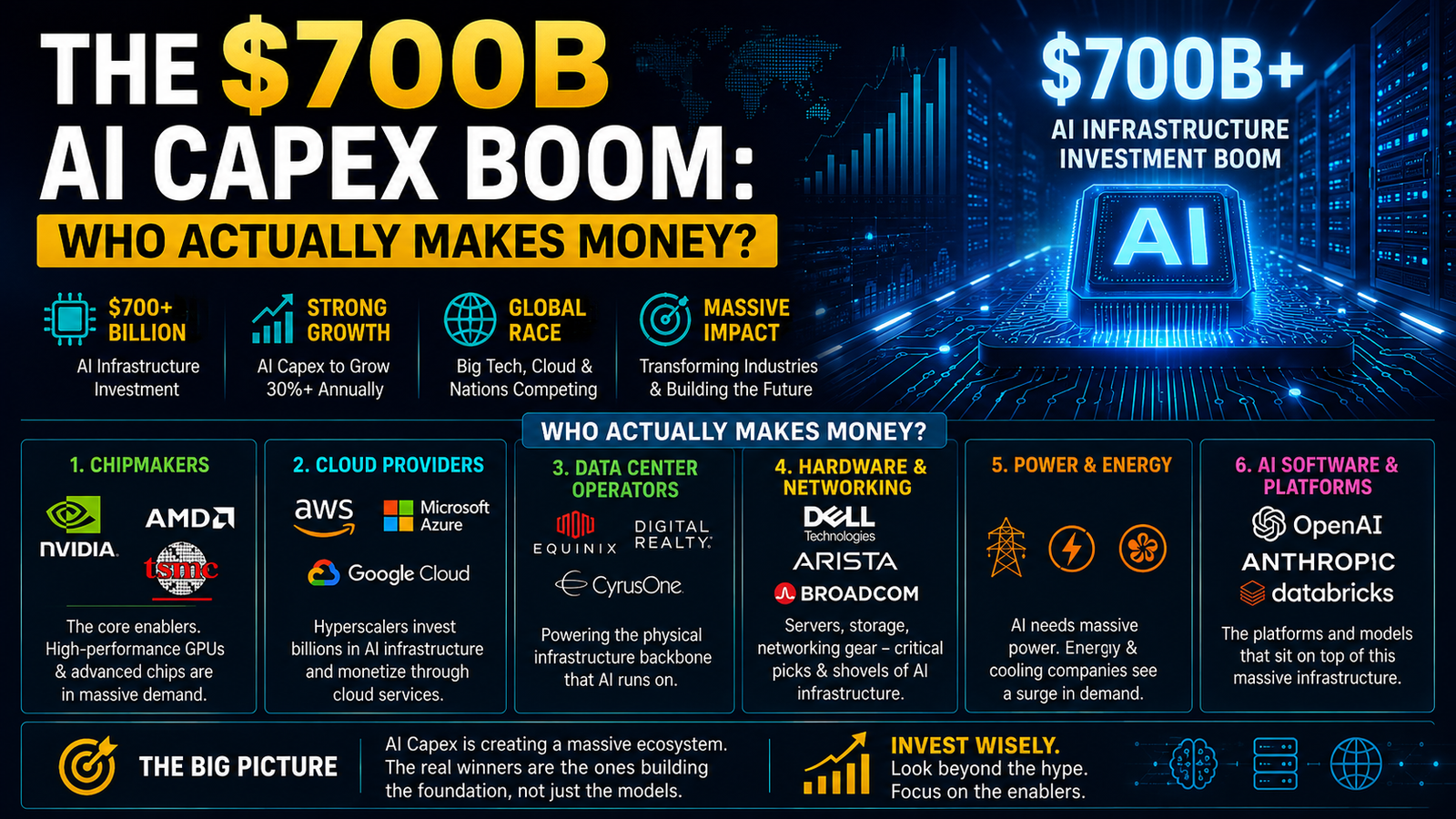
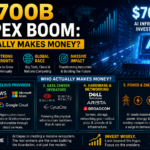
—The “Big Four” hyperscalers—Microsoft, Alphabet, Amazon, and Meta—are now guiding toward a combined $700–725 billion in capital expenditure for 2026, up roughly 60–77% from 2025’s already-record ~$410 billion. Add Oracle and other infrastructure players, and total hyperscaler-adjacent AI capex for 2026 approaches $690 billion+.
companies onThat’s larger than the GDP of most countries, spent in a single year by five or six companies, on chips, data centers, and power infrastructure.
Equity markets have priced this in — and then some. When Meta guided capex even higher in early 2026, its shares fell over 9% in a single session — the market’s first real pushback against the “spend now, profit later” narrative.
MarketsBig Picture Framing: markets aren’t just betting AI works. They’re betting it works enough to justify spending that, in some cases, now exceeds 40–50% of a company’s revenue.
3. The Hidden Constraint Nobody Priced In — Power
The bottleneck for AI growth has shifted. It used to be chips. In 2026, it’s electricity.
- US data center power demand is projected to climb from 31 GW in 2025 to 41 GW in 2026 and 66 GW by 2027—more than doubling in two years (Goldman Sachs Research).
- Globally, data center electricity consumption is on track to roughly double from 485 TWh in 2025 to 950 TWh by 2030 (IEA), with AI-specific demand tripling.
- US data centers’ share of peak summer power demand is projected to jump from 4.1% in 2025 to 8.5% by 2027.
- Roughly 40% of announced AI data center projects face delays tied to power infrastructure, not chips (Gartner).
Unlike chips, the grid can’t scale on a two-year cycle. High-voltage transmission lines take a decade or more to permit and build, and interconnection queues now average five years.
Real-world consequence: communities near major data center clusters in Virginia, Texas, and Georgia are already seeing electricity rates rise 8–15%. This is no longer abstract—it’s on household utility bills.
4. Valuation Math — How Stretched Is “Stretched”?
- Capital intensity (capex as % of revenue) at the largest hyperscalers is running at 45–57%—levels historically tied to capital-intensive industries like utilities, not high-margin software.
- Free cash flow at some hyperscalers is compressing sharply, with at least one major player projected to turn FCF-negative in 2026.
- Revenue from pure-play AI companies (OpenAI, Anthropic, and peers), while growing fast, remains a fraction of the infrastructure investment being deployed on their behalf.
Big Picture framing: This is the classic “picks and shovels vs. gold miners” tension. Infrastructure providers are spending with confidence today; the AI revenue to justify it is still being built.
5. The Bull Case — Why This Might Still Be Early Innings
- Microsoft’s AI business reportedly surpassed a $37 billion annual run rate, up 123% year-over-year, with a contracted backlog suggesting durable demand.
- Google Cloud’s backlog reportedly jumped to over $460 billion.
- Productivity gains are showing up beyond tech — enterprise software, logistics, customer service, and coding tools are reporting measurable efficiency gains.
- Analysts like Jefferies’ Brent Thill argue recent revenue growth genuinely justifies the capital outlay, not blind momentum.
Big Picture framing: both the bull and bear cases are using real data right now. That’s exactly why 2026 is pivotal.
6. Three Things to Watch Through 2026
- Hyperscaler capex-to-revenue ratios in quarterly earnings — the clearest early warning if spending outruns AI revenue.
- Data center power delays and grid interconnection timelines — watch for cancellations tied explicitly to power, not chips.
- Free cash flow trends at the Big Four — sustained compression is the metric that tends to trigger broader repricing.
7. The Big Picture Takeaway
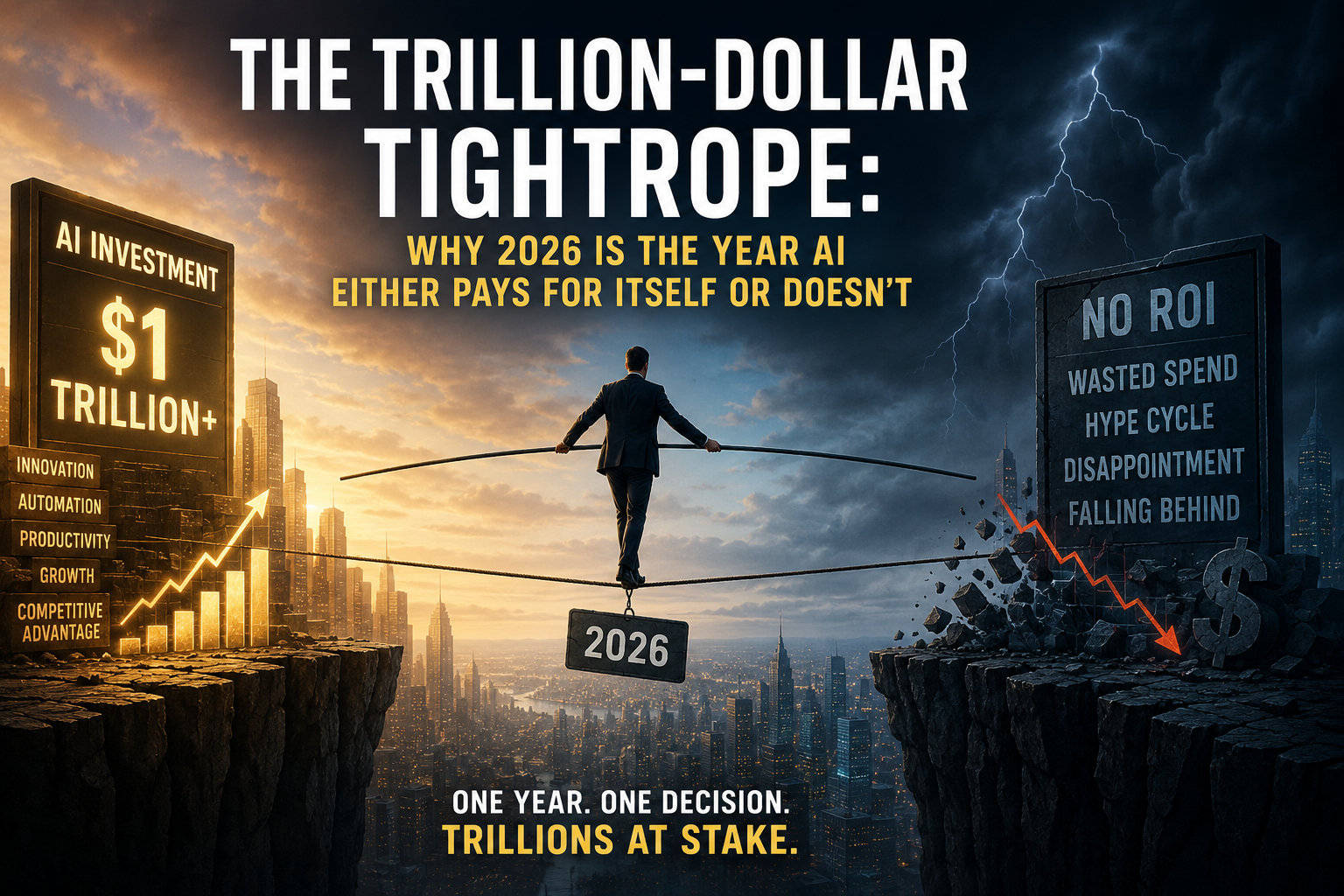
Intensity before AI isn’t a sector anymore—it’s effectively become a macro factor, on par with interest rates or oil prices. 2026’s central question isn’t “is AI real?” The revenue, the backlogs, the productivity gains — those are real. The harder question: can AI deliver productivity gains fast enough to justify today’s valuations and capital intensity before stretched balance sheets, energy constraints, or investor patience force a repricing?
Recommended Reading: 📚 THE LIQUIDITY CYCLE: How Global Money Flows Create Booms, Busts, and Investment Opportunities: An Institutional-Grade Guide to Profiting from Global Liquidity Cycles