







THE GREAT CONVERGENCE: HOW AI IS CREATING A NEW ENERGY INVESTMENT CYCLE
Artificial intelligence is transforming technology, business models and global capital allocation.
But beneath the AI revolution, another transformation is taking place.
The demand for electricity is becoming one of the most important constraints on digital infrastructure expansion.
Major technology companies are investing billions in data centres, computing systems and cloud infrastructure. According to the International Energy Agency, major data-centre operators could spend more than $700 billion in capital expenditure in 2026.
However, building computing capacity requires more than advanced processors.
It requires electricity generation, reliable grid connections, transformers, cooling systems and energy storage.
This creates an entirely new investment landscape.
Why AI is becoming an energy story
Every expansion in computing infrastructure increases demand for physical infrastructure.
Data centres operate continuously. AI training and inference workloads require significant computing capacity. Cooling systems and electrical equipment add further requirements.
The IEA estimates that global data-centre electricity consumption could rise from approximately 485 TWh in 2025 to 950 TWh by 2030.
This creates opportunities across the energy and industrial value chain.
Why India matters
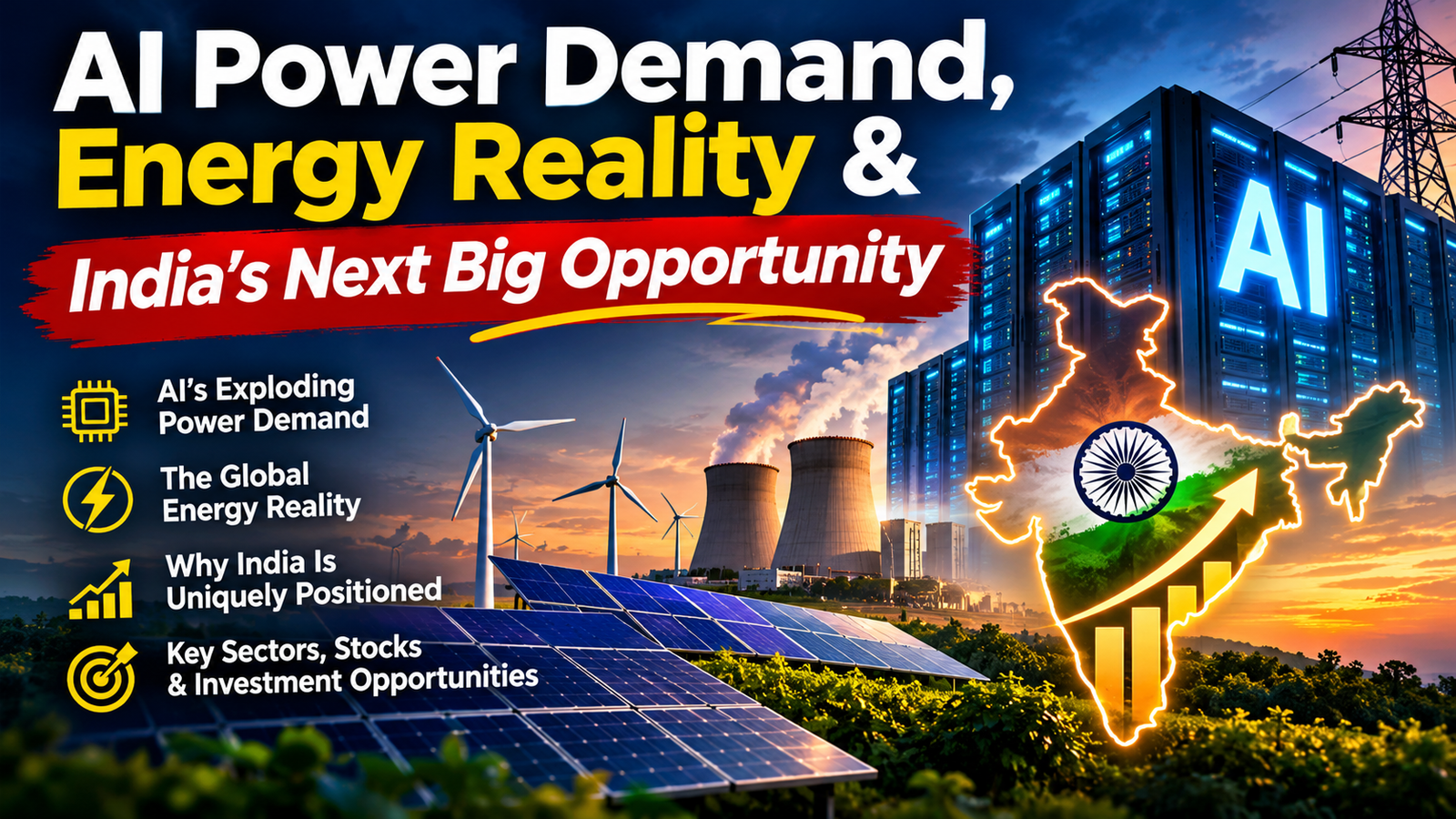
India’s data-centre industry is expanding rapidly.
Installed capacity reached approximately 1.57 GW in August 2026, compared with 375 MW in 2020.
The government estimates that capacity could approach 8 GW by 2030.
This expansion will require significant investment in power supply, grid connectivity, cooling, construction and equipment manufacturing.
Five sectors to monitor
1. Power transmission: Grid expansion and substation development.
2. Transformers and electrical equipment: Equipment required to deliver reliable electricity.
3. Renewable energy and storage: Clean electricity generation and flexible supply.
4. Copper and materials: Industrial inputs for electrification.
5. EPC and infrastructure: Engineering and construction of power and data-centre facilities.
What could go wrong?
Investors must monitor grid bottlenecks, project delays, financing requirements, commodity inflation, geopolitical risks and valuations.
An industry can grow rapidly without every company generating attractive shareholder returns.
The investment conclusion
The next phase of the AI boom may create opportunities beyond semiconductor companies and software platforms.
The businesses supplying electricity, building transmission networks, manufacturing transformers and constructing data centres could become important participants in the global AI infrastructure cycle.
India’s opportunity lies in connecting digital growth with industrial development and energy security.
Recommended reading: The Macro Playbook for the Modern Investor by Amit Rana.
MarketTechGuru — Think Beyond the Headlines.